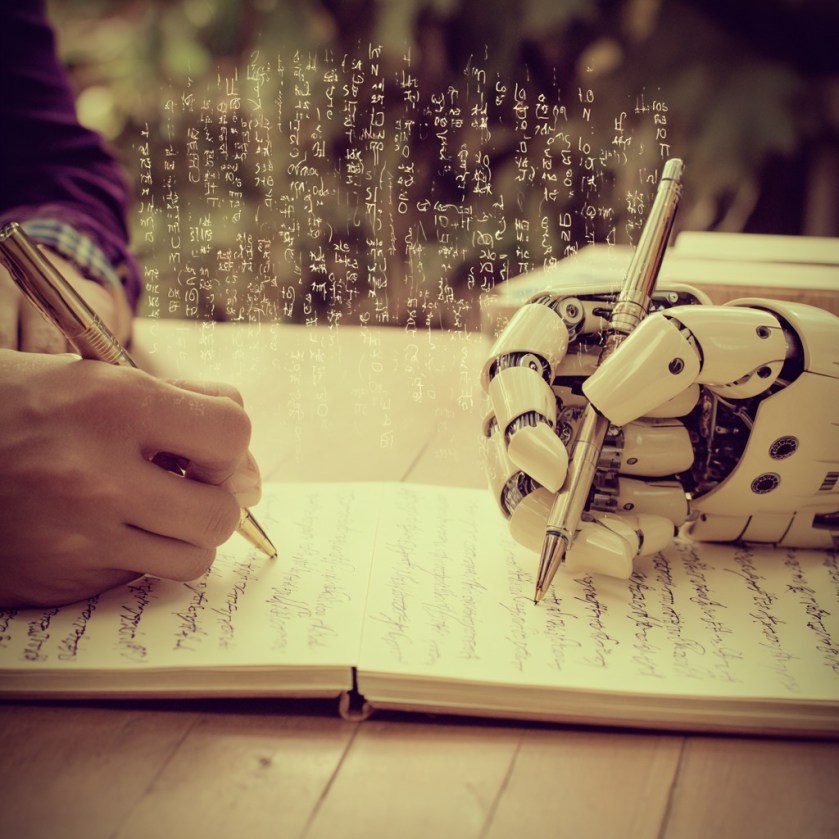
I’ve been wondering about this lately. As someone who experiments with AI to write everything from short stories to blog posts, I often ask myself: does it really matter to the reader who wrote the words, me or the machine? I have a lot of writer friends who say that it does.
But the more I explore, the more personal it feels. I’ve watched people read my AI-written stories with genuine emotion, only for that expression to shift when I reveal the author wasn’t entirely human. It’s in that moment, between curiosity and unease, that I realise we’re in new storytelling territory.
Why Most Readers Don’t Notice at First
When someone opens a story, they rarely stop to ask who wrote it. What matters is whether the words land. Do they make me feel something? Do I want to turn the page? If the story is good, the source barely registers.
In my own experiments, I’ve noticed this repeatedly: readers comment on characters, tone, humour, sadness, but not authorship. The question of “who wrote this?” simply doesn’t arise until prompted.
The research backs this up. According to a 2025 Pew Research Center survey, 76% of U.S. adults say it’s “extremely” or “very important” to know whether something was created by a human or by AI, yet 53% admit they’re “not too” or “not at all confident” they could tell.
That tells us something fascinating: people care about the principle of authorship, but in practice, most can’t, and don’t, spot the difference.
At the moment of reading, the story stands on its own. The emotional connection happens before the label.
What Changes Once They Know
Things change the moment readers find out that AI was involved. The same words, the same sentences, the same rhythm, but now the emotional chemistry shifts.
Even if readers loved the story, they might re-label it as “less authentic” or “lacking soul.” It’s not about the text, it’s about trust. Who’s behind the voice? Why did they write it? What does it mean to them?
This isn’t surprising when you consider how we define creativity. The same Pew study found that 53% of Americans believe AI will make people worse at thinking creatively, and 50% think it will make people worse at forming meaningful relationships. Those are deeply human skills, the very things we look for in stories.
When I’ve revealed that one of my stories was AI-generated, comments often soften. “Interesting,” people say, “but it didn’t feel the same once I knew.” It’s as if the illusion collapses, the same way a magician’s trick becomes less magical once explained.
Are Attitudes Starting to Shift?
Younger generations, raised on blurred boundaries between human and machine creativity, often seem less concerned. To them, authorship is just another creative variable, like choosing a camera filter or editing style. They care more about whether it works than whether it was “pure.”
Globally, attitudes are beginning to follow this pattern. Pew’s international survey found that younger adults are more likely to have heard about AI and more likely to be excited than worried. Older groups, meanwhile, remain more sceptical, seeing AI as a tool that risks eroding creativity rather than expanding it.
I find this generational divide comforting in its way. It reminds me that what seems strange to one generation often becomes second nature to the next. Perhaps our grandchildren will read AI-human collaborations without hesitation, simply enjoying the story for what it is.
So, does the average reader care?
- Not always at the point of reading.
- Often, once they know.
- Less and less, as the world shifts.
What Really Matters
Maybe, in the end, authorship isn’t the question. Maybe it’s impact.
A story, whoever or whatever writes it, succeeds when it stirs something in us. When it makes us laugh, think, remember, or see differently. If AI can help us reach that emotional truth, perhaps the label matters less than we think.
But there’s still something precious about the human signature: the lived moment behind a line, the breath between words, the quiet memory that shaped it. That’s the part no algorithm can replicate, at least, not yet.
Video Overview
Every now and again I put one of my posts through NotebookLM to create a Video Overview. This gives you a chance to listen to the ideas explored in this post. Let me know what you think.
Call to Thought:
Would you still enjoy a story if you found out it was written by AI? I’d love to hear your thoughts, drop a comment below.
About The AI Grandad
Find out more about The AI Grandad on:
YouTube – The AI Grandad
X – The AI Grandad
Facebook – Mike Jackson – The AI Grandad
What do you think AI creativity tells us about ourselves?
Share your thoughts in the comments, I love hearing from curious minds!
Discover more from The AI Grandad
Subscribe to get the latest posts sent to your email.

 The AI Grandad
One thought on “Does the Average Reader Care If a Story Is Written by AI?”