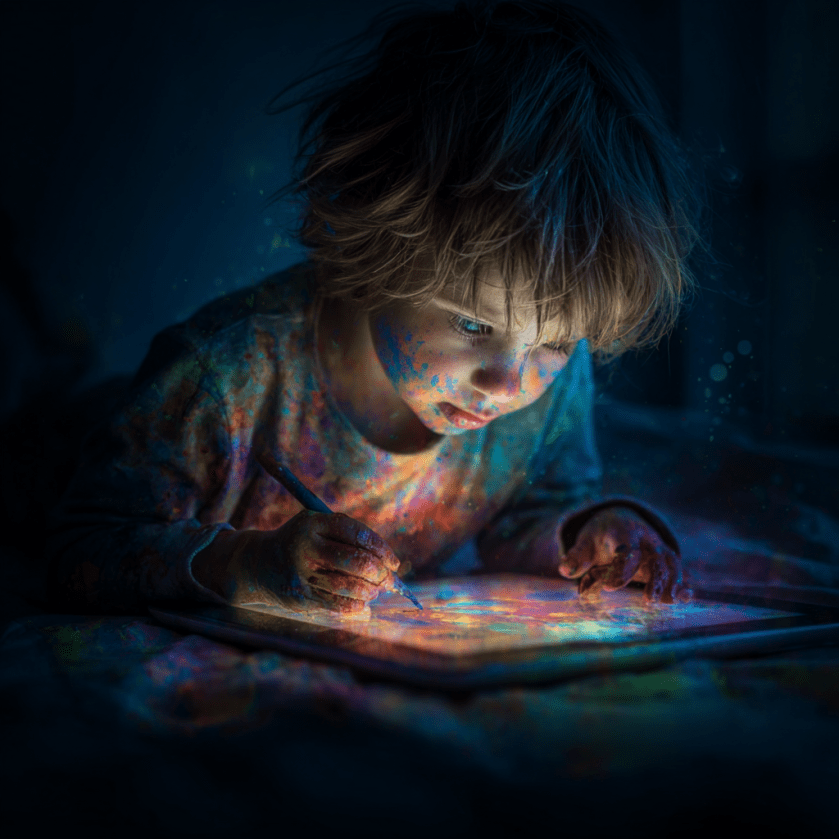
When I was at school, (a long time ago!), “art” meant pencils, paint, and the faint smell of turpentine. We learned about perspective and shading, drew still-life bowls of fruit, and hoped the teacher wouldn’t notice when the apple looked more like a potato.
If you’d told me that one day people would create portraits, landscapes, and dreamlike scenes simply by typing a few words into a computer, I’d have laughed, or worried for humanity. Yet here we are.
I’ve been experimenting with Midjourney, an AI tool that transforms text prompts into visual art. The results can be astonishing, eerie, funny, sometimes breathtaking. But what fascinates me most isn’t the images themselves. It’s the thought that my grandchildren will grow up seeing this kind of creativity not as extraordinary, but as ordinary. For them, it won’t be a revolution, it’ll just be Tuesday afternoon.
From Pencils to Pixels
Watching my grandchildren draw is one of my quiet joys. There’s a beautiful simplicity in the way they grab a felt-tip pen, fill a page with chaotic colour, and then proudly announce: “It’s a dragon eating the moon!”
But I’ve also seen how instinctively they reach for screens, how quickly they navigate drawing apps or design filters. For them, creativity already moves easily between physical and digital worlds.
Midjourney feels like the next natural step: instead of sketching with lines, you sketch with language. You don’t need a brush; you need a vision and a few carefully chosen words. That’s oddly poetic, the painter becomes a poet, and words become strokes of light.
It makes me wonder: maybe the next generation won’t be divided into “artists” and “non-artists.” Maybe they’ll all be visual storytellers, fluent in both words and images.
Democratising Art
When I was young, art felt exclusive. There were those who “had talent” and those of us who didn’t. We were the ones who admired from the sidelines. Materials cost money, classes weren’t always accessible, and a blank canvas could feel intimidating.
AI art tools like Midjourney change that completely. You don’t need expensive materials or years of training. You just need curiosity, and the willingness to play.
That’s what excites me. A child who struggles to draw might still have a vivid imagination. With AI, they can bring that imagination to life in seconds. That’s empowerment. It’s the difference between saying “I can’t draw” and “Let me show you what I see.”
It’s easy to dismiss AI art as lazy or artificial, but I see something deeply human in it: the urge to make, to visualise, to tell stories. Midjourney doesn’t replace creativity, it invites more people to join the conversation.
Imagination Still Matters
Every time I open Midjourney, I’m reminded that technology can only go as far as my imagination will take it. The software can combine ideas, “a castle floating on tea” or “a portrait in the style of Van Gogh, but made of clouds”, but it’s me who decides why those ideas matter.
AI doesn’t know wonder or nostalgia. It doesn’t remember the smell of a school art room or the first time you mixed two colours and made something new. It can only mimic emotion, not feel it. That’s where we come in.
So when my grandchildren ask me about AI art, I’ll tell them this: the machine paints the picture, but you paint the meaning. The prompt is just a doorway; imagination is the key that opens it.
A Thought for the Future
Sometimes I imagine walking into a classroom ten years from now. The walls are lined with hybrid art, part human, part machine. A student stands beside their work, explaining not how they painted it, but how they prompted it.
Perhaps art teachers will guide children to express themes, emotions, and stories through both pixels and pigment. Maybe exhibitions will include the prompts alongside the paintings, as if sharing a poem beside a picture.
If that’s the future, I think it’s rather wonderful. Because art has always evolved, from cave walls to canvas, from canvas to camera, and now from camera to code.
The tools change. The drive to create does not.
Takeaway
AI art isn’t about replacing creativity; it’s about expanding it.
For our grandchildren, the challenge won’t be learning how to draw, but learning how to dream responsibly, with empathy, curiosity, and purpose.
The real art will be in how they choose to use these new tools: not to copy the world, but to imagine better ones.
What kind of art will your grandchildren make when imagination and technology become one?
Video Overview
If you would like to watch a 5 minute video overview of this post, then check out, Painting The Future, on my YouTube Channel. The video was created by NotebookLM.
Discover more from The AI Grandad
Subscribe to get the latest posts sent to your email.

 The AI Grandad
One thought on “Painting the Future: What AI Art Means for the Next Generation”