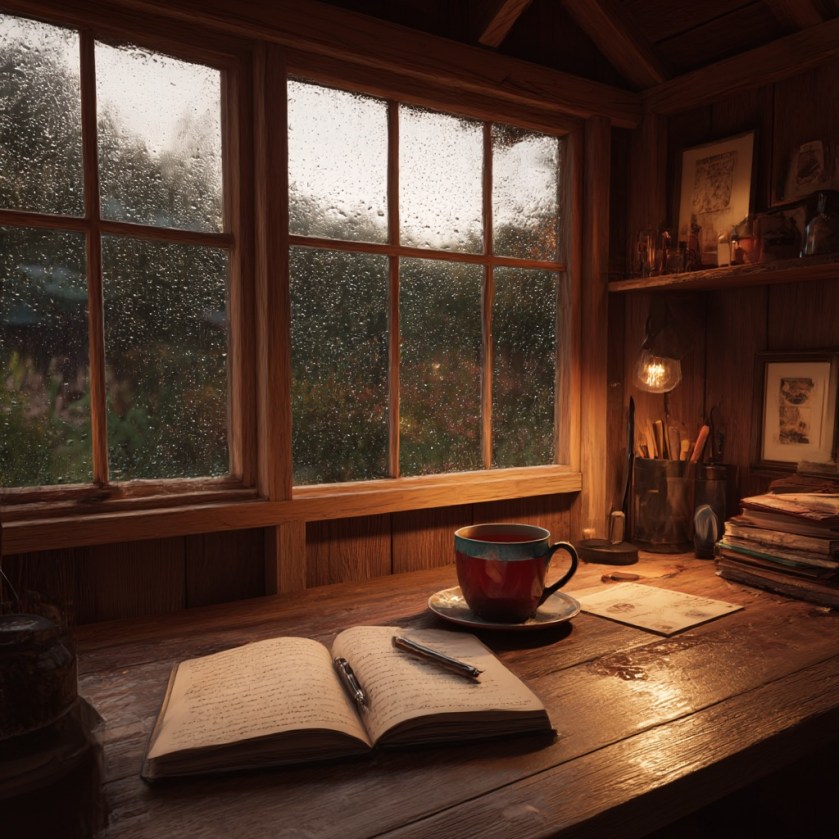
I still remember the first time AI genuinely surprised me. Not the usual mild amusement you get when a new gadget works as advertised, but a proper jolt, the creative equivalent of discovering a forgotten ten-pound note in an old coat. I was in my shed, rain machine-gunning the windows, halfway through a cup of tea that had already gone cold thanks to my talent for distraction.
On a whim, I typed a ridiculous prompt into my newly discovered ChatGPT. Something about a time machine made of teapots. I expected a polite refusal or a nonsensical mess. Instead, a complete little story appeared. A proper story. One with a beginning, middle and end. It felt oddly personal, as if the machine had peered into my shed, and decided to have a bit of fun with me.
That was the moment I realised I wasn’t simply dealing with a tool. I was dealing with a spark, the kind imagination sometimes needs.
The Question That Comes Up Again and Again
The more I share these AI-fuelled experiments on the blog, the more I hear a particular worry whispered, or sometimes declared loudly by writers clutching their quills like defensive hedgehogs:
“Is AI replacing imagination?”
It’s a fair question. An understandable one. And definitely a human one.
This post is my attempt to answer it properly, not with quick reassurance, but with the depth it deserves. Because the truth is far more interesting than either fear or hype. And it begins with the simple recognition that imagination is not a fragile relic from childhood. It is a living, shifting companion that grows with us, hides from us, and sometimes, if we’re lucky, finds its way home again.
Imagination Doesn’t Retire When We Do
For years, without really meaning to, I’d subscribed to the quiet idea that imagination belonged mostly to children. They’re experts at it, after all. They can transform a cardboard box into a pirate ship, a scarf into a snake, or a muddy puddle into a portal to the underworld, usually while you’re wondering whether your washing machine can cope with any more of their adventures.
Adults, on the other hand, are supposed to specialise in the dull-but-necessary: bills, appointments, practical solutions, and knowing roughly where the car keys are. Imagination becomes something we joke about, or dabble in on holidays, or admire in other people.
But here’s the revelation AI handed back to me: imagination never left. It simply went quiet. Life piles enough sensible tasks on top of it that we forget how to hear it. But it’s always there, waiting, patient as anything.
When I retired, creativity came back… slowly, like a shy cat. Then AI arrived and, strangely enough, flung the door wide open. Suddenly imagination was not just back, it was bounding around the room, full of exciting energy.
If you’ve read my earlier post about curiosity and ageing, you’ll know I believe wonder isn’t something we lose, it’s something we stop feeding.
So What Is Imagination, Really?
When people debate whether AI “has imagination,” I suspect we’re often talking about different things. If imagination were simply the ability to produce new combinations of ideas, then yes, AI is extremely good at that. Almost too good.
But the imagination I grew up with, the imagination I saw in thousands of children over my teaching career, is something quite different.
Human imagination is stitched together from memory and emotion. It’s shaped by every moment we’ve lived, every person we’ve loved, every job we’ve taken too seriously or not seriously enough. It’s the sum of our fears, hopes, regrets, longings, and the small triumphs nobody else noticed. It is, in its essence, deeply personal.
That’s why no AI, no matter how advanced, can replicate it. It has no lived experience. It has no internal weather map. It has no private history that bruised or blessed it.
AI can remix.
AI can surprise.
But only humans can mean.
AI Isn’t Replacing Imagination, It’s Stretching It
This is the part where I always lean forward, because here’s the twist: AI doesn’t diminish imagination. It expands it.
It reminds me of when I got my hearing aids. Suddenly I was hearing hings that were silent a moment earlier. The sounds and voices had always been there, the hearing aids just made them reachable.
Since experimenting with AI, I’ve found myself imagining in wider circles. Stories I never would have written have appeared because some odd, off-beat AI suggestion nudged me sideways. Visual worlds I never would have drawn came alive because Midjourney threw me something bizarre. Even my cosy mysteries and my more sinister drabbles have taken on flavours I doubt I’d have discovered without a bit of digital mischief.
AI hasn’t replaced my imagination. It has enlarged the room it runs around in.
But Let’s Address the Big Fear: Could AI Replace Creativity?
Here’s the truth I’ve come to, slowly and with much tea – AI can generate.
But only humans can choose.
People misunderstand creativity when they imagine it’s all about producing words or images. Anyone can type. Anyone can doodle. AI can do both at astonishing speed.
But creativity isn’t typing. Creativity is deciding. It’s the act of choosing which idea to follow, which detail to amplify, which line carries truth, which twist feels right, which ending matters.
AI can produce infinite possibilities. But only you can say, “Ah, that on! The imagination isn’t the machine producing 50 options. It’s the human heart knowing which option has meaning.
Writing With AI – Less Like a Threat, More Like a Conversation
If writing used to feel like sitting in an empty room waiting for inspiration to turn up (and inspiration, like our cat, only shows up when it feels like it), then writing with AI feels like having company. It doesn’t tell me what to write. It asks what else I might try.
It’s like a curious apprentice who is endlessly enthusiastic but occasionally absurd, the sort of assistant who might fetch you a spanner when you asked for a spoon, but also hands you ideas you didn’t know you were capable of.
And when you push it, gently or not-so-gently, it pushes you back. Not with competition, but with possibility.
AI Helped Me Rediscover a Lost Habit: Asking “What If?”
“What if?” is the birthplace of imagination. Children ask it constantly. Think back to when your children were small. That constant barrage of “What if?” and “Why?” questions that seemed never ending. I’m sure my two boys spent their sleeping hours coming up with more questions to ask me when they woke up!
Unfortunately as we get older, we seem to forget to ask “What if?” at all. But AI practically begs for it. Type anything at all into a text box, and the whole system hinges on your willingness to ask a question.
What if a village by the sea hid something supernatural?
What if dreams were rationed in an alternate London?
What if my shed contained a portal to somewhere unsettling?
What if Shakespeare wrote crime scenes?
Once you start asking again, you don’t stop. And the imagination you thought had retired sends you a postcard to say “put the kettle on, I’m on my way back.”
Children vs Older Adults: Two Ends of the Creative Spectrum
I’ve noticed something delightful. Children and older adults often respond to AI with equal excitement, but for completely different reasons.
Children see AI as a toy box that has accidentally been left unlocked. Everything is possible, and they accept this without blinking. AI fits perfectly with their instinctive belief that the world is secretly magical and slightly unhinged.
Older adults, on the other hand, see AI as a key, a key that opens a door they thought was permanently closed. We have the experience, the emotional depth, the nostalgia, the sense of story. What we sometimes lack is the energy or the confidence to begin.
AI supplies the spark. We supply the soul. Put a child and a grandparent together with an AI prompt, and you can practically hear the imagination crackling between them.
Why AI Feels Like a Creative Revival in Later Life
Something unexpected happens when you start experimenting with AI in your seventies. Instead of feeling old, you feel, dare I say, younger. Or perhaps “younger” isn’t quite the word. More awake.
There’s something undeniably invigorating about learning a new skill, especially one that refuses to be predictable. You find yourself feeling curious. You begin trying things you’d never have tried before. You discover that imagination isn’t this delicate thing that fades away, it’s resilient, stubborn, and eager to stretch its legs.
AI hasn’t made me creative.
It has made me braver about being creative.
It hasn’t replaced my experience.
It has woven itself around it.
It hasn’t erased my voice.
It has amplified it.
But Is It Still “My” Creativity? Without a Doubt
I’m often asked whether a story is still “mine” if AI helped somewhere in the middle. I understand the worry, it comes from a good place, a place that values authenticity. But here’s what I can say with absolute confidence:
It’s mine because I shaped it. Because I chose it. Because it reflects my life, not the machine’s data.
AI has no childhood. No grief. No nostalgia for the days when school assemblies involved overhead projectors and crackling microphones. No emotional reaction when a story unexpectedly connects with a memory it didn’t know it carried.
That part, the human part, cannot be automated.
My Creative Life Before AI… and After
Before AI, creativity surfaced in little pockets. I’d write occasionally, usually when the stars aligned and the kettle wasn’t calling my name. Ideas came gently. Slowly. Like visitors who weren’t sure if they were welcome.
After AI, the pace changed completely. Creative ideas show up unannounced, like old friends popping round because they heard the kettle boil. Stories multiply. Curiosity hums. There’s an energy that wasn’t there before, not because AI is doing the imagining for me, but because it’s prompting me to imagine more bravely.
And that, at seventy-five, feels like rediscovering a part of myself I thought had quietly slipped away.
So… Is AI the New Imagination?
No. AI isn’t imagination. AI is the lamp you switch on. Imagination is the hand holding it.
AI is the trampoline. Imagination is the courage to jump.
AI is the spark. Imagination is the fire you choose to build from it.
Technology opens the door. Humans walk through it. Imagination has always belonged to us.
A Final Thought for the Curious
If you’re wondering whether AI might stir something in your imagination, something that has been quietly waiting for years, here’s my suggestion:
Try one small experiment. Ask one daft question. Start one playful prompt.
You might just find that imagination hasn’t gone anywhere. It’s simply been waiting for you to knock on its door again. And AI, in its strange and astonishing way, hands you the key.
Call to Thought
If this post stirred something in you, a spark, a question, a half-forgotten I’d love to hear it. Drop a comment below and tell me how AI has surprised you, confused you, inspired you, or nudged your imagination awake.
Your thoughts help shape future posts, and they remind me that this little adventure isn’t a solo journey, it’s a conversation. So go on… what might you imagine next?
About The AI Grandad
Find out more about The AI Grandad on:
YouTube – The AI Grandad
X – The AI Grandad
Facebook – Mike Jackson – The AI Grandad
What do you think AI creativity tells us about ourselves?
Share your thoughts in the comments, I love hearing from curious minds!
Discover more from The AI Grandad
Subscribe to get the latest posts sent to your email.

 The AI Grandad
One thought on “Is AI the New Imagination? A Grandad’s Guide to Navigating Wonder”