The Question Everyone Tiptoes Around
Whenever the topic of AI and creativity comes up, someone inevitably leans forward and whispers, almost conspiratorially, “But surely it won’t replace real writers and narrators?”
I sip my tea, tilt my head, and say, “Well… it might.”
I don’t say this with doom in my voice. No shaking fists. No Shakespearean cries of “Woe, the end is nigh!” Just a gentle shrug and a kind of affectionate curiosity, the sort you might feel watching a magician pull a toaster from a top hat. You’re not horrified; you’re simply thinking, “Well, I wasn’t expecting that… do it again.”
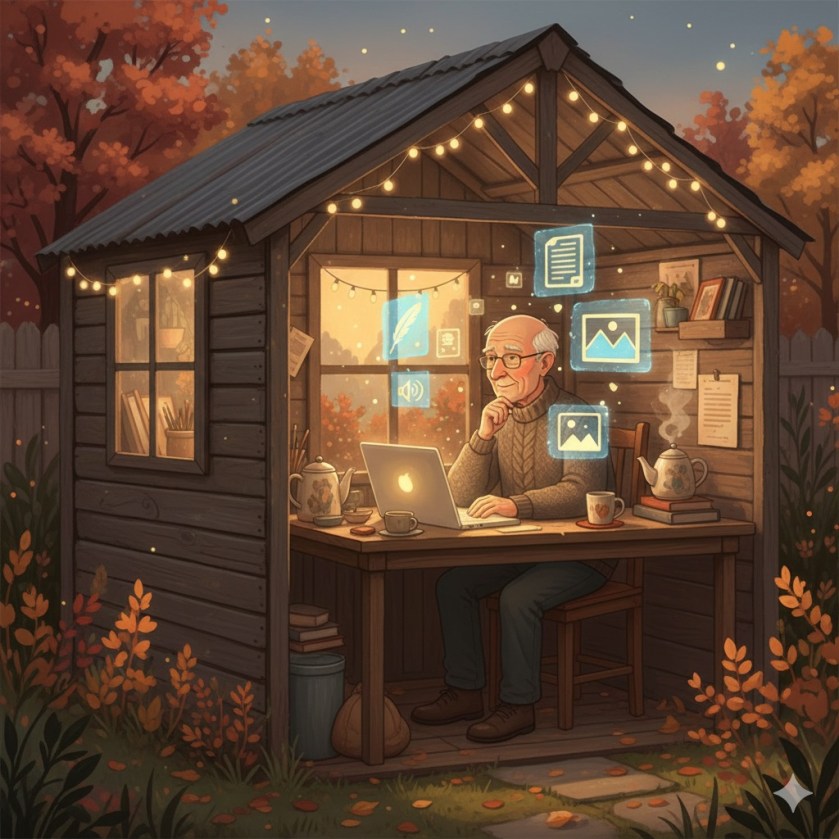
Because after two years of building an AI-powered creative life in my little garden shed, surrounded by old books, knick knacks, notebooks, and a slightly judgmental spider, I’ve learned this:
AI probably will replace some creative jobs. But it won’t replace creativity, and it certainly won’t replace the peculiar, irreplaceable quirks of being human.
Instead of running from it, I’ve chosen to walk right up to the machine, give it a biscuit, and say, “Right then, let’s see what you can do.” (And what it can do is rather astonishing.)
The Big Shift No One Really Wants to Name
Let’s be honest for a moment. Creative work has always been precarious. Writers, illustrators, narrators, copywriters, journalists, audio editors, bloggers… none of us were perched on the firm, granite throne of job security. Many of us were clinging to the rock face with ink-stained fingers, praying the biro wouldn’t slip.
Then AI turned up and cheerfully announced, “Right. Let’s tidy these loose rocks, shall we?”
I honestly feel that naming the shift is important. Because the moment you name something, it stops lurking in the shadows and starts looking a lot more like something you can work with. And the shift is this:
Machines can now do many creative tasks faster than humans. Not the entire craft. Not the whole creative identity. But tasks. The building blocks.
Drafting. Editing. Narrating. Sketching. Summarising. Creating mock-ups. Animating stills. Structuring story beats. Cleaning audio. Generating music. These used to be full jobs. Now they’re simply pieces, and pieces can be rearranged
What AI Is Already Better At Than Us (and Why That’s Not a Bad Thing)
Some people go twitchy at this bit, so I’ll tread softly. AI is already outperforming humans in areas like:
- creating story drafts at lightning speed
- producing clean narration at almost no cost
- designing unique images in minutes
- animating still illustrations
- editing text with monk-like patience
- summarising long documents without complaint
- fixing pacing, structure, clarity, and tone
- turning scripts into podcasts
- generating mood-based soundtracks
- converting ideas into videos faster than you can flick the kettle on
These used to take teams, budgets, and endless hours. Now? Now I can do them in an afternoon, from my shed, wearing slippers that have seen better days.
And here’s the essential thing: This isn’t a loss. It’s a larger playground.

So Why Am I Not Panicking?
This is where some people assume I’ve gone a bit eccentric. (Fair enough, I’m a 75-year-old man running an AI-powered creative studio out of a wooden shed.) But AI hasn’t diminished my creativity. It’s expanded it.
Here’s what AI has done for me:
- given me a bigger imagination
- increased my creative output
- lifted the weight of self-doubt
- helped me work across multiple mediums, writing, audio, video, images
- opened doors to audiences I would never have reached
- allowed me to build blogs, podcasts, YouTube channels, and stories at a pace one human couldn’t manage alone
I used to be a writer. Now I’m a story architect, an image curator, an audio producer, and a tiny-budget film director with a cast of digital apprentices who never sleep. If you’d like the full tale of how this all started, I shared it in Falling Down the AI Rabbit Hole: How Curiosity Led Me to Midjourney and ChatGPT.
AI didn’t take anything from me. AI opened rooms I didn’t even know were in the house.
Humans Never Lose Creativity. We Just Change Shape.
Every time a new technology arrives, people fear the death of creativity. But let’s look at history:
- the camera didn’t kill painting
- the synthesiser didn’t kill orchestras
- the typewriter didn’t kill handwriting
- photography didn’t kill portraiture
- Wikipedia didn’t kill curiosity
- smartphones didn’t kill novels
- the printing press didn’t kill storytelling, it multiplied it
Technology doesn’t erase creativity; it redistributes it. It reshapes the land, creates new hills and valleys, shifts the light.
And older adults, my generation, are uniquely positioned to thrive.
You no longer need perfect eyesight, fast typing fingers, or the stamina of a teenager. You need curiosity. And, ideally, a biscuit.
AI is a tool that levels the playing field for those who thought their creative days were behind them. (Spoiler: They’re not).
The Jobs AI Might Replace (But Not the Voices Behind Them)
Let’s talk plainly. AI will likely replace certain roles:
- entry-level copywriting
- basic editing
- routine illustration
- low-budget audiobook narration
- simple video editing
- data-heavy journalism
- standard social media content
- transcription and captioning
- certain types of educational content
But here’s the line in the sand: AI cannot replace your voice, your memories, your lived experience, or your emotional truth.
AI can imitate emotion, but it cannot feel it.
AI can generate stories, but it cannot live one.
AI can reflect humanity, but it cannot carry it.
Not yet, anyway, and maybe not ever. Jobs may shift. But storytellers remain.
A Small, Honest Question
What if, instead of fighting the shift, you explored it for a week? Just seven days of curiosity.
What might you create?
What might surprise you?
What new version of yourself might appear?
(It happened to me. It could happen to you.)
How I Stay Joyful in a Rapidly Changing Creative World
I could choose fear. But curiosity makes a much livelier drinking companion. Here’s how I stay upbeat:
1. I treat AI as a teammate, not a usurper. It drafts. I shape. It offers. I choose. I remain the meaning-maker.
2. I enjoy the surprises. Sometimes it writes something brilliant.
Sometimes it writes something so bad I laugh out loud. Both moments are gifts.
3. I lean into the fun. If you can’t enjoy transforming a five-second Midjourney clip into a narrated micro-film using ElevenLabs…
What are you doing with your retirement?
4. I focus on the very human things. Context. Emotion. Memory. Curiosity.
The deliciously messy stuff.
5. I embrace reinvention. Being 75 doesn’t mean slowing down.
It means discovering new toys and playing with them enthusiastically, even if the grandchildren look at you like you’’re crackers.
A Personal Note: I’m Not Pretending
I’m not hiding the fact that:
- my stories are often AI-generated
- my images are AI-made
- my narration is sometimes AI
- my videos are AI
- my blog posts are heavily AI-assisted
- my entire creative process is intertwined with machines
Why hide it? This is the future, and I’m in it with both feet.
I’m not a “traditional writer” anymore. I’m the director of a buzzing creative workshop staffed by patient digital apprentices who never complain, never get migraines, and never need a tea break.
I’ve thought a lot about authorship and honesty in AI-assisted work, especially in Can a Machine Write Better Fiction Than Me?.
That’s not a downgrade. That’s an evolution.
What AI Has Given Me That I Didn’t Expect
Here’s the surprising bit: AI has made me more human. It has reminded me:
- how much I love storytelling
- how energising it is to learn something new
- how exciting it is to reinvent yourself
- how joyful it feels to create with abandon
- how deeply I value curiosity, community, and conversation
It has also shown me that fear often masks excitement, a truth I wish I’d learned earlier. AI hasn’t hollowed out my creativity. It has helped me rediscover it.
A Reflection on Generations: Why Older Adults Should Lean In
Let me speak directly for a moment to my fellow grandparents, retirees, and “I only use my iPad for Facebook” friends: AI is not something to fear. It’s something to explore.
We grew up through black-and-white TVs, rotary phones, cassette players, home computers, the internet, smartphones, and now AI. We’ve adapted before. We’ll adapt again.
And do you know what? Older adults make brilliant AI creators. Why?
Because we’ve lived. We’ve made mistakes. We’ve survived heartbreaks, illnesses, strange fashion choices, world changes, and at least one disastrous attempt at DIY.
AI can generate content. But only we can generate perspective. That’s our superpower.
Closing Reflection: Creativity Isn’t Dying, It’s Evolving
Yes, AI is moving fast.
Yes, some creative jobs will fade.
And yes, new ones will appear in the most unexpected places.
But the one constant, the one unshakeable truth, is this: Humans will always need to create. We’ll always want to tell stories, share memories, connect, laugh, cry, and make sense of the chaos around us.
AI doesn’t replace that impulse. It amplifies it. It bends it. It gives us new shapes, new textures, new rhythms to play with. And if you ask me, that’s something worth leaning into.
NotebookLM Video Overview
I have made of NotebookLM to create a video overview of this post. Let me know what you think of it.
Call to Thought
How do you feel about this shift? If you stopped resisting and started experimenting, even just a little, what might you discover about your own creativity?
f you’re wrestling with mixed feelings about all of this, you’re not alone. I explored that in Why Some Writers Feel Uneasy About AI.
I’d love to hear your thoughts in the comments.
About The AI Grandad
Find out more about The AI Grandad on:
YouTube – The AI Grandad
X – The AI Grandad
Facebook – Mike Jackson – The AI Grandad
What do you think AI creativity tells us about ourselves?
Share your thoughts in the comments, I love hearing from curious minds!
Discover more from The AI Grandad
Subscribe to get the latest posts sent to your email.

 The AI Grandad