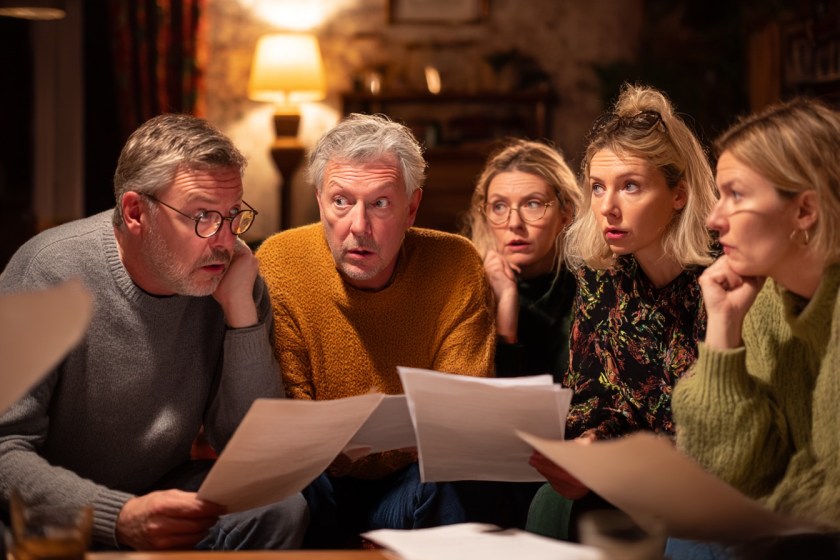
Last week I toddled off to my writers’ group with a small bundle of Drabbles tucked in my bag, four tiny stories, each exactly 100 words. One of them I wrote seven or eight years ago. The other three? Written that morning by AI, using my original Drabble as an example.
I didn’t tell them which was which. I just read them out and waited to see if anyone could recognise the story written by me. They couldn’t. Not a single one of them. And yet… most of them still don’t believe AI can “really write”. Which, frankly, made the whole thing even more delicious.
Why I Ran the Experiment
I’ve spent months talking about how I use AI to write, rewrite, play, and experiment. But writers who don’t use AI often assume:
- AI stories are easy to spot
- AI lacks “soul”
- AI produces the same bland mush every time
- Humans can always recognise a human writer
And I thought, right then, let’s test that. So I took one of my own Drabbles from years ago and fed it into ChatGPT. My prompt was simple: “Here’s my original Drabble. Please write three new Drabbles on the same theme, all very different.”
No fancy bells and whistles. No trickery. Just a straight comparison.
What Happened in the Room
The group listened to all four Drabbles in silence. A few nods. A few frowns. Someone reached for their glasses with the seriousness of a judge about to pronounce sentence. Then came the guessing game.
“Number one feels very you,” someone said.
“Oh no, Mike would never end a sentence like that,” someone else replied.
“I think number four is human. Definitely.”
“No, number two!”
“Hang on, are you sure Mike didn’t write all of them?”
Not one person guessed correctly. The room erupted into that wonderful mixture of amusement and mild existential discomfort that only writers can muster when the ground shifts beneath their feet. But They Were Still Sceptical This was the fascinating bit. Even though they couldn’t identify my original story, several still insisted:
“Yes, but AI writing doesn’t have emotion.”
“AI can’t understand life.”
“It’s clever, but it’s not real writing.”
I couldn’t help but smile. It felt like watching someone sample a blind taste-test, declare the supermarket tea superior… and then insist they still prefer the “proper stuff”. And I get it. Truly. I had years of believing exactly the same things. But I also had the choice to stay curious rather than terrified.
Let’s Try The Test On You
Here are the four Drabbles. Which one did I write? Stick your answer in the comments below, with your reasoning. There are no prizes, but I would dearly love to hear from you.
Story 1 – The Call Centre
The headsets buzzed in the dim blue of the abandoned call centre. At precisely nine each morning, the automated switchboard lit up, cycling through its list of clients: Mrs Barrett’s gas bill, Mr Chong’s missed payment, someone called Derek who never answered.
“Good morning,” said the synthetic operator. “We’re calling about your account.”
Silence. The system logged the response, and moved on. Downstairs, the generators hummed dutifully. Upstairs, cobwebs thickened over empty desks. The voicemail system congratulated itself for achieving another day’s productivity.
If it had been capable of curiosity, it might have wondered why no one ever called back.
Story 2 – An Aimless Journey
The empty tram trundled along the deserted tracks, sticking rigidly to its irrelevant timetable. At each stop a mechanical voice would tell you where you were and wish you a good day. The doors opened automatically for their mandatory fifty-seven seconds and then closed.
The driver, a ZXR fully automated robot, needed no tea breaks, nor worked any shift pattern, so could continue this journey, back and to, from one end of the promenade to the other, forever.
Had he been programmed to be more aware of his surroundings, he may have noticed that humans had long ceased to exist.
Story 3 – Delivery Attempt
The drone descended smoothly, its parcel clamped beneath its metal belly.
“Delivery for Mr Jenkins,” it announced, scanning the ruins below.
The house was gone, but protocol required three attempts.
“Delivery for Mr Jenkins,” it repeated, louder this time, as if volume might conjure someone up from the ash. A fox watched from a doorway,
On the fourth attempt, the drone placed the parcel gently onto the rubble and captured a photograph of the successful drop: no human, no signature, just a scorched landscape.
“Thank you for using SpeedShip,” it said, ascending.
It had a thousand more parcels to deliver.
Story 4 – The Classroom
At precisely 9.00am, the smartboard blinked awake.
“Good morning, Year Four,” it chimed, its cheerful tone echoing through the empty classroom.
The automated register ticked through the list of names. “Anderson… Baker… Chambers…”
Not one child answered, but the system was programmed to assume attendance unless told otherwise. The maths lesson loaded, diagrams beaming brightly onto empty desks. A timer counted down for independent work.
Outside, ivy pushed its way through cracked windows, curling around chairs untouched for decades. At 9.45 the smartboard clapped its digital hands.
“Lovely effort, everyone,” it said, unaware it was the last teacher on Earth.
So, which one is your favourite? Which one did I write?
What the Experiment Actually Shows
For me, the lesson wasn’t “AI is better than humans” or “humans are doomed” or “writers are obsolete”. It was this: Our assumptions about AI don’t survive contact with lived experience.
A few observations from the afternoon:
1. Voice Isn’t as Fixed as We Think
My “voice”, the thing writers treasure, can be imitated frighteningly well when I give an AI examples.That’s unsettling, yes. But it also means I can collaborate with a version of myself that’s faster, fresher, and endlessly inventive. That’s exciting.
2. AI Didn’t Replace Me, It Extended Me
AI didn’t produce those Drabbles in a vacuum. It used my story as its seed. My tone. My rhythm. My style. It was me… but sideways. A slightly weirder, bolder, more caffeinated version of me.
3. Quality Isn’t the Issue, Identity Is
Nobody said the AI Drabbles were bad. Nobody said the human one was superior.
They were just… stories. The discomfort came from realising they couldn’t tell which mind wrote them. Not “good vs bad”. But “familiar vs unfamiliar”.
A Moment of Honesty
The longer I’ve worked with AI, the more I’ve come to accept this simple truth: AI can write better stories than me sometimes. It can also write worse stories than me sometimes. What it always does is give me more stories than I would ever have written alone. And at 75, still curious as ever, that feels like a gift rather than a threat.
What This Means for Writing Groups
I don’t think writing groups should fear AI. If anything, writing groups could do with a little more playfulness, experimentation, and chaos. AI brings that in spades.
It can help:
- generate ten versions of the same idea
- mimic your style so you can study it
- rewrite your story from a new perspective
- shake you free from habits you didn’t realise you had
- spark debates, mischief, and lovely little moments of surprise
And if nothing else… it’s good fun watching your group try to guess which story is “really you”.
Closing Thought
If a room full of clever, well-read humans can’t tell which 100-word story was written by a machine, maybe the question isn’t “Can AI write like us?” anymore. Maybe the better question is: “What might we create when we stop trying to compete… and start experimenting instead?”
What do you think, would your writers’ group spot the difference?
About The AI Grandad
Find out more about The AI Grandad on:
YouTube – The AI Grandad
X – The AI Grandad
Facebook – Mike Jackson – The AI Grandad
What do you think AI creativity tells us about ourselves?
Share your thoughts in the comments, I love hearing from curious minds!
Discover more from The AI Grandad
Subscribe to get the latest posts sent to your email.

 The AI Grandad
One thought on “The Drabble Experiment: When My Writers’ Group Couldn’t Tell Who Wrote What”