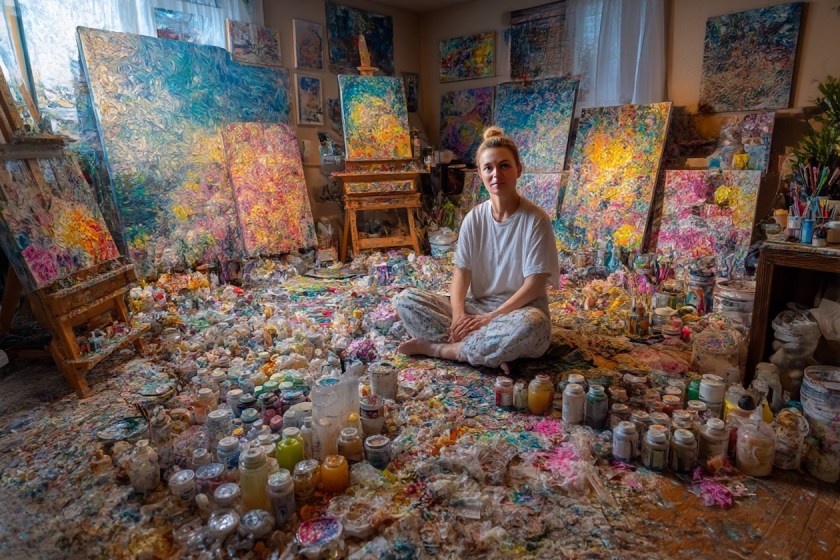
If you’d told me twenty years ago that one day I’d be creating stories, images, videos, and audio with the help of a machine that lives in my browser, I’d have smiled politely, nodded, and quietly assumed you’d had a funny turn.
Yet here we are. I’m seventy-five, tapping away in my little shed at the end of the garden, watching as creativity spills out of me faster and more joyfully than it ever did when I had a school to run and assemblies to plan. And the strange thing is, I’m not overwhelmed by this new era. I’m energised by it.
Because despite the noise, despite the panicked headlines, despite the grumbling in certain corners of the writing world, something extraordinary is happening. We’ve entered the age of creative abundance. And abundance changes everything.
It changes how we write, how we learn, how we collaborate, and even how we judge what’s “good.” But abundance doesn’t have to flatten us or cheapen us. With the right mindset, it can lift us. It can make us braver. And it can remind us that creativity was never about guarding our tiny patch of land, but about exploring the whole landscape.
This is the world we now share. A world where ideas teem, multiply, collide, remix, and spark without waiting for permission. The challenge is no longer scarcity, it’s orientation. The question is no longer “Can I make something?” but “What do I want to make, and why?”
So let’s talk about what this new era really means, and more importantly, how to thrive in it without feeling flattened by the sheer scale of it all.
The End of the Gatekeeper Era
I sometimes think back to my early teaching days when creative writing meant pencils, lined paper, and whatever ideas you could coax from a group of eight-year-olds on a wet Monday morning. Publishing meant books in a library or magazines on a shelf. Audio meant a tape recorder with a red button you prayed wouldn’t stick. And images meant carefully cutting out pictures from newspapers for displays. It was a charming, homemade period of creative life. But it was also profoundly limited.
If you wanted to create something beyond your immediate materials, you needed resources. Access. Approval. Money. Gatekeepers stood tall and unshakeable, deciding whose stories could travel and whose voices remained tucked away in exercise books.
That era shaped us. It made creativity feel scarce and precious. It made the very idea of being a “writer” or “artist” feel like a club you had to be invited into. Then the internet cracked the doors open, but only just. You could share things, yes, but tools were clunky and access uneven.
Now? Well, let’s just say the club walls have dissolved, the velvet rope has dropped into the mud, and the bouncer has gone home for a nap. Anyone can make something. Anyone can publish something. Anyone can learn a technique that would have taken months twenty years ago.
This is the new creative plenty, and it’s generously overflowing And while some people react to it with panic, “There’s too much! I can’t keep up! How do I stand out?”, I find myself breathing out more deeply. Because abundance isn’t a threat to creativity. Abundance is creativity finally being allowed to stretch.
Why More Creators Doesn’t Mean Less Creativity
I often hear people say that creativity will become meaningless when “everyone” can do it. But that doesn’t match how people actually behave. When cameras became cheap and easy, not everyone became a photographer. When blogs appeared, not everyone became a writer. When the smartphone opened up a recording studio, not everyone became a musician or a podcaster.
The truth is simple: creativity has always been something people choose, not something they’re forced into. And even in a world rich with possibility, most people won’t bother if they’re not drawn to it. Some will dabble. Some will try a handful of times. Some will noodle around for the joy of it.
But a much smaller group, people like you, me, the curious, the restless, the idea-hunters, will keep going. And we’ll keep going not because we have to but because something inside us insists on it.
This wide-open creative world doesn’t dilute creativity. It simply shines a light on the people who were always meant to make things. It reveals who the creators always were. When the tools are cheap and the stakes low, you’re free to experiment, to chase that odd idea, to switch genres without anyone giving you a sideways look. You can try a hundred small things and discover what you care about. In a scarce world, every mistake was costly. In an abundant world, every mistake is a lesson.
The New Skill: Discernment
If creativity is the wild forest, then discernment is the compass. With so much content floating around, the old skill of “being able to produce” is no longer enough. The new skill, the one the best writers, artists, and storytellers will develop, is being able to see clearly.
To see what resonates.
To see what’s yours.
To see what’s noise.
To see what you want to say.
Discernment is the ability to choose your influences wisely. To curate your inputs. To sense when a piece of AI output contains a seed worth nurturing, and when it’s simply filler. It’s the confidence to say, “I like this direction. Let’s go deeper,” or “No, that’s too obvious. Let’s turn it.” Discernment doesn’t come from machines. It comes from experience, attention, and the willingness to listen closely to your own taste.
Taste is the quiet compass behind everything you make. It’s the thing that shapes your voice, guides your choices, and nudges you towards the ideas that feel most like you. And in this wide-open creative world, where everyone has access to the same tools, your taste, your eye for what feels right and what doesn’t, is the real difference-maker. Tools can be copied. Style can be mimicked. But the way you choose, refine, and trust your instincts? That’s your signature.
Why Curators Are Becoming Just as Important as Creators
One of the most surprising shifts in this era is the rise of the curator, the person who sorts, selects, organises, and elevates. In a world drowned in content, the people who bring clarity become indispensable. We already see this everywhere: book reviewers who help us find hidden gems, YouTubers who sift through mountains of ideas to highlight the good ones, bloggers who demystify complex tools or summarise complicated essays.
Curators aren’t second-rate creators. They’re creators in a different form. Their medium is attention. And the lovely thing is, many of us do both. Some days I’m writing short stories, shaping a podcast episode, or working on a cozy mystery. Other days I’m simply exploring and sharing what I’ve found, the oddities, the experiments, the mistakes, and the surprises. Both are creative. Both add value. Both matter.
Embracing Play, Curiosity, and Lightness
Perhaps the greatest gift abundance gives us is permission – permission to be playful again. When creativity was scarce, it felt heavy. Every piece had to count. Every story had to be your best. Every attempt had to prove something.
Now you can open a blank page with a sense of mischief.
“What shall we try today?”
“What if I combine a folk tale with a bit of sci-fi and a dash of humour?”
“What if I let AI write something terrible and see whether I can make it better?”
Play is where creativity actually lives. It loosens the edges, opens new paths, and lets ideas surprise you. My grandchildren show it perfectly, they don’t brood over every idea like a writer wrestling with their first chapter; they just dive in and muck about. AI brings some of that spirit back to us. A bigger canvas, softer rules, and far more room for joy.
The Myth of the “Good Enough” Flood
One of the concerns people raise is that AI will drown us all in “good enough” content, content that isn’t brilliant, but isn’t awful either. I understand the fear, but I don’t share it, because “good enough” has never won hearts. The stories we remember, the art that endures, the ideas that live inside us for decades, are never the ones that merely scraped by.
“Good enough” disappears.
“Good enough” blends.
“Good enough” doesn’t stay with anyone.
Abundance highlights quality. It doesn’t erase it. Imagine being in a market with fifty stalls, you’ll gravitate to the ones with authenticity, flavour, and heart. You won’t remember the forgettable ones.
Readers, viewers, and listeners have always been discerning, often more than we give them credit for. The difference now is that they have more choice, and that means the people who create with intention, care, curiosity, and genuine voice rise naturally above the mass.
Why Older Voices Matter More Than Ever
A quiet truth sits beneath the surface of this whole conversation: abundance hasn’t only opened opportunities for the young. It’s blown open the door for older creators too. People like me. People who spent years, maybe decades, thinking it was too late to start a new project, or return to an old passion, or try something completely ridiculous just because it sounded like fun.
We’re the ones with stories inside us that haven’t been written. We’re the ones with memories, humour, scars, life experience, and a sense of perspective young creators can’t fake. AI can help us share these stories faster, easier, and with more confidence. It lowers the technical barriers that used to hold us back. It lets us create without wrestling with software manuals or fiddly editing tools.
In abundance, older voices are not drowned out. They’re amplified. Because what we bring, the lived experience, the humour, the gentleness, the understanding of what truly matters, becomes the steady heartbeat beneath all the noise.
The Surprising Benefit of Letting Go
Abundance invites a wonderfully liberating shift: the permission to let go of perfection. When there’s no shortage of ideas, you don’t have to cling to your mistakes. You don’t have to agonise over every comma. You can release work quickly, learn from it, adjust, try again. You can move lightly.
Creativity becomes less like sculpting marble and more like gardening, planting, pruning, tending, experimenting, and accepting that some things bloom and some things don’t. But in a garden of abundance, there’s always something growing somewhere. And that realisation changes your whole relationship with the creative process.
That’s the real power of abundance: it frees us from the tight grip of scarcity thinking. It encourages experimentation, and experimentation leads to discovery.
Thriving in Abundance Means Choosing Intentionally
In the end, thriving in this new era isn’t about producing more or faster. It’s about paying attention. Paying attention to what excites you. Paying attention to what you want to explore. Paying attention to which ideas pull at you, even when you’re doing something else.
Thriving means letting go of the fear that someone else will create the thing you wanted to create. They might, and that’s fine, but they won’t do it the way you would. They can’t. Your perspective is your fingerprint.
Thriving means allowing creativity to be fun again, not solemn. It means letting AI help, without letting it take charge. It means staying curious, staying playful, staying connected. It means remembering that abundance isn’t competition, it’s an invitation.
And it’s an invitation we’re lucky to have. Because for the first time in history, you can create freely, widely, joyfully, without permission or gatekeeping. Your stories can reach people across the globe. Your ideas can blossom into formats that didn’t exist twenty years ago. Your curiosity can become a weekly post, a podcast episode, a YouTube Short, or a project that surprises you entirely.
This is the era of creative abundance. It’s something to enjoy. It’s a landscape built for explorers. For tinkerers. For storytellers. For late bloomers. For the curious. For the brave. For the thoughtful. For everyone who still has something to say. For people like us.
Call to Thought
We’re living through a once-in-a-generation shift in how stories are made and shared. So here’s the question I keep circling back to: In a world where anything can be created, what do you feel most called to create, and why now?
I’d love to hear what abundance makes possible for you.
About The AI Grandad
Find out more about The AI Grandad on:
YouTube – The AI Grandad
X – The AI Grandad
Facebook – Mike Jackson – The AI Grandad
What do you think AI creativity tells us about ourselves?
Share your thoughts in the comments, I love hearing from curious minds!
Discover more from The AI Grandad
Subscribe to get the latest posts sent to your email.

 The AI Grandad