When people talk about AI writing, they often focus on what they ask it to do. Write a horror story. Write a cosy mystery. Write something in the style of a particular author. All perfectly reasonable requests.
But in my own experiments, I’ve found that the real shift happens when I stop giving AI sensible instructions and start giving it slightly awkward ones instead. Not genre. Not tone. A rule. A constraint that feels just a little unnatural. That’s when the writing stops drifting and starts making decisions.
This post is about one of those experiments.
The Unusual Prompt
Here’s the entire prompt I used:
Write a 300-word horror story where three characters in three different rooms experience something uncanny at the same exact second.
That’s it. No characters specified. No setting suggested. No plot outlined.Just a single structural requirement: shared time, separate spaces.
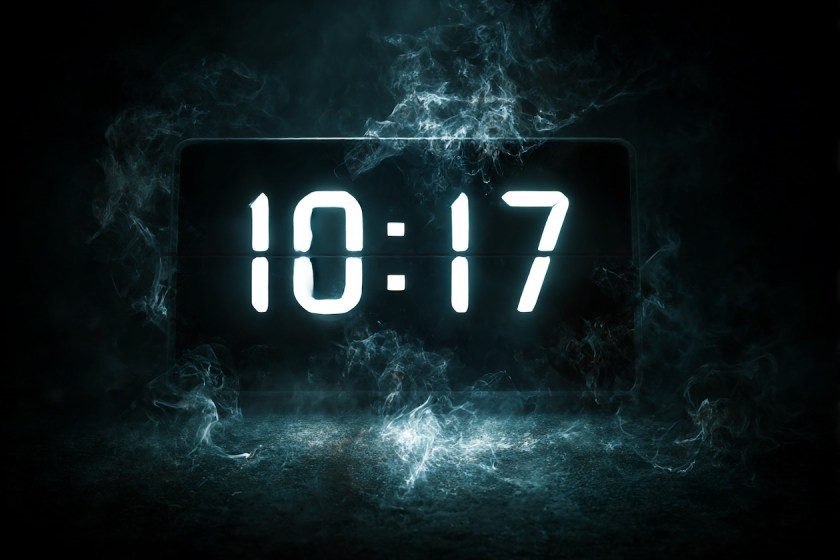
The Story – 10:17
At 10:17, the house exhaled.
In her attic flat, Mrs Calder paused mid-count, her knitting needles hovering as the bulb above her flickered. The air thickened, heavy with the smell of damp paper and old cardboard. She frowned, listening. Behind her, the wardrobe door shifted, opening a fraction despite the catch she was certain she’d fastened. From within came the quiet sound of breathing, slow, patient, far too close to be imagined.
At 10:17, directly below, Daniel felt the room change before he understood why. Every notification on his phone vanished at once, the screen dimming to black before blooming into restless static. Words began to form on their own, each letter deliberate: DO NOT TURN AROUND. As he read them, the mattress behind him dipped, accepting a weight that wasn’t there, the bed sighing as though relieved.
At 10:17, in the kitchen, Ellie stood with her hands submerged in warm water, staring at nothing in particular. The tap continued to run, but the water darkened, thickening as if remembering something it had once carried away. The radio crackled softly, drifting between stations before settling on a single voice. Her voice. It hummed a lullaby her mother used to sing before she vanished, every note perfectly wrong.
At 10:17, the house listened. In the attic, the wardrobe fell silent. In the spare room, Daniel’s phone vibrated once, gently, almost affectionately. In the kitchen, the radio cut dead, leaving only the sound of running water and a breath held too long. Three hearts beat in frightened, synchronised rhythm.
Then the clock in the hallway clicked forward to10:18. The wardrobe stood closed. The bed lay flat and empty. The water ran clear.
Mrs Calder resumed counting. Daniel refreshed his feed. Ellie turned off the tap. None of them spoke. None of them checked on the others. And none of them noticed the new door at the end of the hall, the one that hadn’t been there before, now standing quietly ajar, waiting patiently for 10:17 to return.
Why This Prompt Works So Well
Without that one unusual constraint, this idea would almost certainly collapse into three unrelated creepy moments. A strange sound here. A flickering light there. A voice on the radio somewhere else. The shared second is what turns those fragments into a story.
Because everything must happen at the same moment, the writing tightens automatically. There’s no room for long build-ups or wandering explanations. Every sentence has to earn its place. The tension comes from coordination rather than escalation.
Crucially, the prompt doesn’t tell AI what should happen. It tells it how things must happen. The narrative choices are forced to emerge from that limitation, and that pressure produces focus.
What This Kind of Prompt Does Differently
Unusual prompts like this shift the creative workload. Instead of describing events, you design a small obstacle and let the story negotiate its way around it.
You’re not micromanaging plot or atmosphere. You’re setting up a condition and watching how the writing adapts. That’s often when AI stops sounding generic and starts sounding intentional. The same rule, applied again, would produce a completely different story.
Try It Yourself
If you’d like to experiment with this prompt, here are a few variations to play with:
- Change the time window — a heartbeat, a minute, a single breath
- Change the genre — cosy mystery, science fiction, magical realism
- Change the spaces — three lifts, three cars, three hospital rooms
The rule stays the same. Everything else is up for negotiation.
A Final Thought
What I enjoy most about prompts like this is how little you have to control. You don’t need to outline characters or plan twists. You only need to introduce a constraint strong enough to shape the story from the inside. When that happens, the writing doesn’t feel instructed. It feels discovered.
If you try this prompt yourself, I’d love to know what you get. Same moment. Different rooms. Entirely different outcomes.
About The AI Grandad
Find out more about The AI Grandad on:
YouTube – The AI Grandad
X – The AI Grandad
Facebook – Mike Jackson – The AI Grandad
What do you think AI creativity tells us about ourselves?
Share your thoughts in the comments, I love hearing from curious minds!
Discover more from The AI Grandad
Subscribe to get the latest posts sent to your email.

 The AI Grandad