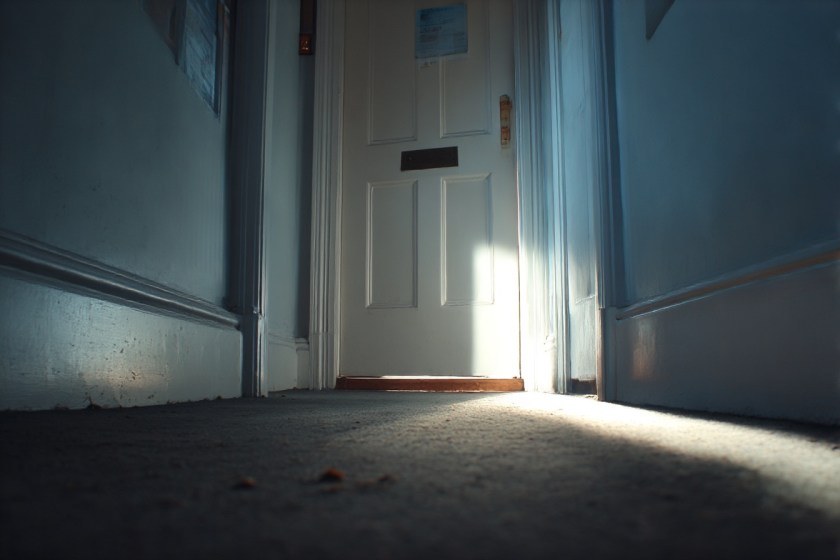
This experiment began with a simple question: what changes when the centre of a story is shifted away from the people in it?
Rather than asking AI to invent a character with feelings, motivations, or a backstory, I asked it to write from the perspective of a door. Not a symbolic door. Not a magical one. Just a door that opens, closes, and stays where it is. The constraint was not technical. It was perceptual. The door can only know what passes directly in front of it.
That immediately removes some of the usual narrative shortcuts. The door cannot explain why someone hesitates. It cannot interpret an argument, a departure, or a return. It can only register patterns. Who arrives at the same time each morning. Who lingers. Who does not come back. Meaning has to emerge indirectly, through repetition and absence, rather than through insight or emotion.
The Story (Created by Claude)
Number Twelve
I am the second door on the left. There are others, but I don’t know them.
A young man lives here. He opens me quickly and closes me the same way. He doesn’t linger. In the mornings he smells of soap. In the evenings he smells of something else, kitchens, I think. Grease and heat. His hands are always damp when he touches my handle.
He has a phone. I know this because he speaks into it in the corridor, before he unlocks me. He laughs sometimes. Other times he is quiet and only listens. I hear half of every conversation. The other half happens somewhere I cannot reach.
A woman started visiting. Fridays. She knocked twice, softly, and he opened me before the second knock finished. They went inside together and I did not see them again until she left, late, when the corridor lights had dimmed to their night setting. This continued. I don’t know for how long. Fridays became Fridays and Saturdays. Then some Wednesdays. She stopped knocking. He gave her a key.
Her key sounds different from his. Lighter in the lock. She turns it slowly, as if she is not quite sure it will work. Then it does, and she enters, and I close. For a while they left together in the mornings. His soap smell and something else, something floral that clung to the air after she passed. They walked close. I felt this in the way they moved through me, nearly simultaneous, a single interruption rather than two. Then it changed.
She began leaving earlier. He stayed behind. I would open for her, close, and then nothing for an hour. Sometimes two. Then he would leave, quickly, the way he always did. They stopped leaving together.
I don’t know what happens inside. I face the corridor. I see the fire extinguisher. The carpet with its pattern of faded squares. The door to number eleven, which opens less often than I do.
She came on a Friday, recently. She didn’t use her key. She knocked. He answered. They stood in my frame, neither in nor out. I felt the cold from the corridor mixing with the warmth from inside. They spoke quietly. I could not hear the words, only the rhythm, short sentences, long pauses. Then she left. She didn’t go inside.
He closed me and I heard him sit down just behind me. Close to the door. On the floor, I think. He stayed there for some time. I felt his weight against my base, slight but present.
The key came back through my letterbox three days later. It landed on the mat with a small sound. He picked it up. I don’t know what he did with it. He still leaves in the mornings. Still returns smelling of kitchens. He still speaks into his phone in the corridor, but the laughing has stopped. Now he only listens, and then he unlocks me, and goes inside.
Last night someone knocked. A man’s knock, heavier. The young man opened me. They went out together. He didn’t come back until very late. He fumbled with the key. Missed the lock once. Then found it.
This morning he left later than usual. He paused in my frame, hand on my edge, looking back into the flat. I don’t know what he was looking at. He pulled me shut.
The corridor is quiet now. The lights have shifted to their daytime setting. Number eleven has not opened yet. The fire extinguisher sits in its bracket. The carpet squares continue their faded pattern toward the stairs.
I wait. Something will happen, or it will not. I am the second door on the left, and I will still be here when it does.
My Thoughts
What interested me most was how calm the voice remained. There is no drama in the telling, yet the story still accumulates weight. The door notices different people coming and going, changes in routine, the sound of keys. None of these details are important on their own. Together, they suggest lives in motion, decisions being made, and time passing, all without the narrator ever understanding any of it.
This kind of experiment highlights something easy to miss when working with AI. When you restrict knowledge rather than creativity, the writing often becomes more precise. The AI is forced to stay within its lane. It cannot over-explain. It cannot reach for metaphor as a shortcut. It has to attend to what is actually observable.
It also reframes what we mean by perspective. This is not about novelty or cleverness. It is about asking who usually gets to speak in a story and what is lost, or gained, when that assumption is quietly removed.
I did not change the output much. That felt important. The value of the experiment sits less in polish and more in the way the viewpoint shapes the reading experience. It is a small shift, but it alters the entire tone of the piece.
Discover more from The AI Grandad
Subscribe to get the latest posts sent to your email.

 The AI Grandad
One thought on “What Happens When the Door Tells the Story”