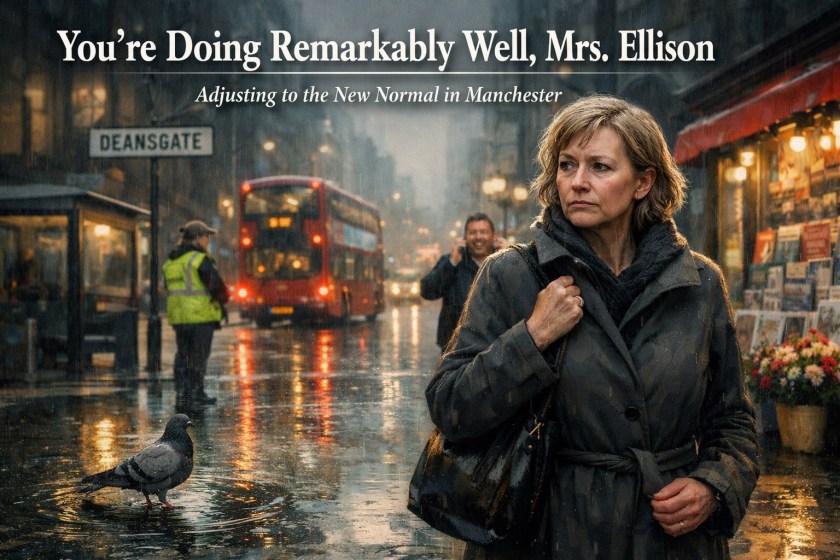
Every now and again I give an AI a single prompt and let it write a short story. I do not edit the result. I simply choose one worth keeping. Below you will find the exact prompt, the story it produced, and one brief thought that stayed with me after reading. Nothing more.
This week I used Claude.
The Prompt
Write a 300-word story set in a near-future Britain where grief has been made illegal, not mourning itself, but the outward display of it. Your protagonist has just attended a Compliance Appointment, the state-mandated check-in for those who have recently lost someone. Write the scene immediately after they leave the building.
The Story
After
The appointment ran fourteen minutes over schedule. Sandra noted this on her way out, because noting things was easier than feeling them.
Outside, the Compliance Centre smelled of rain and exhaust. March in Manchester. She pulled her coat tighter and walked, because the form she’d signed said walking is encouraged as a mood-regulating activity and she was, above all else, a person who followed instructions now.
She had ticked every box. She had confirmed that she was progressing through the adjustment period in a manner consistent with community wellbeing. She had smiled at the right moments. not too wide, not too brief, and the Assessor had made a small, satisfied mark in the margin of her file.
David had been dead for eleven weeks.
At the corner of Deansgate, a pigeon stood very still in a puddle, water pooling around its feet, unbothered. Sandra stopped and watched it for longer than was probably advisable. A woman in a high-vis jacket glanced at her, a glance with edges to it, and Sandra straightened up, rearranged her face, moved on.
The Assessor had said: You’re doing remarkably well, Mrs. Ellison.
She had said: Thank you. I’m committed to the process.
What she had not said: He used to make me tea before I woke up. Every morning for thirty-one years. I don’t know how to be awake.
She passed a newsagent. A florist. A man laughing into his phone. She kept walking. At the bus stop, she pressed her thumbnail into her palm, hard, harder, just to feel something that had a shape to it. The bus came. She got on.
The Thought
What interests me about this premise isn’t the dystopia itself, it’s how quickly Sandra internalises it. She doesn’t rage against the system. She files herself into its spaces, ticks its boxes, wears its acceptable face. The horror isn’t the law; it’s how efficiently she has learned to comply.
That feels true to something. Grief, even without state interference, often teaches us to perform wellness long before we feel it. We smile at the right moments. We say I’m doing okay because the alternative, the real answer,takes up too much room in a conversation.
Discover more from The AI Grandad
Subscribe to get the latest posts sent to your email.

 The AI Grandad