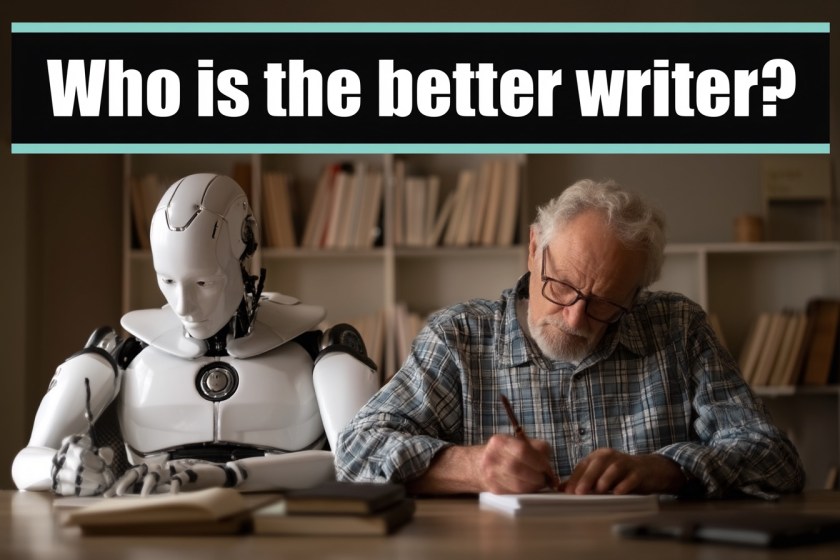
Two in the morning, and I’m staring at a story the AI has generated. It’s good. Genuinely good. The prose flows. The structure works. The edit I’d been planning to make, the one where I’d tighten the third paragraph and sharpen the dialogue in the second half, it turns out the machine already saw that. It’s already done it. Better than I would have.
So I sit there thinking: what exactly am I doing here?
This is the question that keeps me awake more than any of the usual anxiety about authorship and authenticity. Because I’ve made my peace with the idea that I’m not writing in the traditional sense anymore. I’ve accepted the role of editor, director, curator, whatever you want to call it. But what happens when the machine is genuinely good at editing too? What happens when it catches things I miss, structures things I wouldn’t think to structure, judges its own work with a discernment that rivals my own?
If the AI is a good writer and a good editor, then what role am I actually playing?
The Disappearing Act
The honest answer is that I don’t entirely know. And I think that uncertainty is closer to the truth of where we actually are with these tools than any confident assertion about what writers will become.
Let me be clear about what I mean. The machine isn’t just faster than me. It’s not just more prolific. In many practical ways, it’s actually better. It can generate a thousand variations of a paragraph without fatigue. It can read its own work with the kind of detachment I struggle to maintain. It doesn’t get attached to sentences that sound pretty but don’t earn their weight. It doesn’t have ego invested in a particular narrative turn. In a lot of ways, that makes it a better editor than most people will ever be.
So when I’m selecting between its options, when I’m saying yes to this version and no to that one, what am I actually doing? Am I choosing, or am I just pointing? There’s a real difference between those two things, and I’m not certain which one applies to me anymore.
Taste Without Knowledge
There’s a long literary tradition that says taste is what humans bring. Taste is supposed to be the irreducible thing, the thing that can’t be automated. You develop taste by reading deeply, widely, across years and decades. You build it through failure and refinement and the slow accumulation of pattern recognition. Taste is supposed to be the mark of the serious reader, the serious writer.
Except the machine has read everything I’ve read, and a thousand times more. It’s absorbed every pattern I’ve absorbed, plus millions more that I’ll never encounter. So when I’m selecting one option over another, am I exercising taste or just preference? Preference is much smaller than taste. Preference is whim. I prefer the angry version of the character over the sad version, sure. But that’s not taste. That’s just what appeals to me in the moment.
Taste is built on knowledge, and knowledge is increasingly something the machine possesses in greater abundance than I do.
The Weight of Choosing
Here’s something that gnaws at me though. Choice without consequence is a strange thing. When a writer sits down and commits to a sentence, to a narrative decision, to a particular way of approaching a scene, they’re staking something on it. They have to live with that choice. It will carry their fingerprints. If it fails, they fail.
When I’m selecting from the machine’s endless options, am I staking anything? Or am I just pointing?
There’s a difference between authorship and curation, and I think the difference might be precisely this: authorship requires vulnerability. It requires that you’ve risked something real. Not just your ego, though that too. But something deeper. The writer is saying: this is how I see the world, this is what I believe matters, and I’m willing to be judged on that basis.
When you’re curating, when you’re selecting from pre-existing options, the stakes feel different. Smaller. You’re not responsible for the options themselves, only for which one you chose. And that feels like it matters less somehow.
The Absence of Struggle
Writing is supposed to hurt a little. Not melodramatically. I’m not talking about the romantic myth of the tortured artist. But genuinely. You reach for something you can’t quite grasp. You fail. You try again. You find a sentence that almost works and you live with it for three days and then you change it because you finally understood what you were actually trying to say.
The machine doesn’t experience that friction. It generates fluently, endlessly, without the weight of trying to make something true. And if I’m just selecting from its infinite options, do I get to keep the struggle? Or have I outsourced that too?
Maybe the struggle is what actually makes it mine. Not the words, not even the structure, not the final edited product. The struggle. The trying. The reaching for something real and falling short and having to live with the imperfection because at least it’s authentic.
What’s Left
So what is my role, if the machine can both write and edit better than I can?
The honest answer might be simpler than I want it to be. Maybe I’m just the one who wants something. I want to tell a particular story. I want it to feel a certain way. I want readers to see themselves in it. I want to say something true about loneliness, or absurdity, or the peculiar melancholy of English gardens in November. The machine can craft all of that. It can execute it beautifully, probably better than I could. But I’m the one who wanted it in the first place.
Maybe that’s everything. The wanting. The intention that matters to me, even if I can’t execute it perfectly. Maybe that’s what authorship means now. Not the execution. The wanting.
Or maybe it’s nothing. Maybe it’s a consolation prize, something I tell myself to feel less irrelevant in a landscape where the tools keep getting smarter and I’m not sure what my actual contribution is anymore. I don’t know. And I think that’s okay to admit.
What I know is this: I want to make things. I want to have something to say. I want the work to be good, and I want it to be mine in some way that still feels real, even if I can’t quite define what that realness consists of anymore.
The machine is very good at the mechanics of writing. Better than good. But wanting something, having taste shaped by your own particular life, your own particular preoccupations, your own particular way of seeing the world? That still seems to belong to me. At least for now. At least until I figure out what I actually mean by it.
That’s where I live. In that uncertainty. And maybe that’s the only honest place to write from anymore.
Did you enjoy this post? What are your thoughts? I would enjoy reading them. Why not drop me a line in the comments below?
Before You Go Check Out…
Behind The Curtain — A Conversation About Creativity
Discover more from The AI Grandad
Subscribe to get the latest posts sent to your email.

 The AI Grandad