A couple of posts ago I gave you a story called, ‘The Puddle I’m Sitting In’. The prompt I gave Claude was:
‘The scene is a wet and windy city centre. A homeless man is sat on a wet blanket outside a shop on the High Street. Busy people are hurrying by. Write an evocative 500-word monologue in the voice of the homeless man.’
I then wondered what Claude might do with the same image but from a different point of view?
Bring In The Alien!
So, this is the next prompt I gave Claude:
Can you now take the same scene and this time write a 500 word report from the voice of an alien creature. He has been sent to survey Earthlings and their behaviour in readiness for an alien invasion. He has to write a report to his Commander In Chief who is in the command ship circling the planet.
The New Story – Surveillance Report #847-B
SURVEILLANCE REPORT #847-B TO: Commander Zyloth, Primary Invasion Fleet FROM: Observer Unit Krell-9 LOCATION: Urban Center Grid Reference 51.4°N, 0.1°W SUBJECT: Behavioral Anomaly Requiring Strategic Assessment
Commander, I must report a puzzling phenomenon that may impact invasion protocols.
I have positioned myself in what the natives call a “city centre” to observe their social patterns during adverse atmospheric conditions (liquid precipitation, high wind velocity). The specimens move in predictable streams, prioritising shelter and commerce. Their clothing technology appears adequate for environmental protection, though their mobility is impaired by unnecessary aesthetic choices, particularly the females’ elevation footwear.
However, Commander, there is an anomaly.
One specimen sits motionless on the ground outside a commercial establishment. He is exposed to the full force of the precipitation. His coverings are inadequate, saturated fabric, degraded synthetic materials. Initial assessment suggested possible injury or biological malfunction, but scans indicate standard physiological function. He is simply… sitting.
What disturbs me, Commander, is the behaviour of the other specimens toward him.
They do not assist. They do not investigate. They actively avert their visual sensors as they pass, some adjusting their trajectories to maximise distance from him. I have observed 247 individuals pass this location in the last standard cycle. Three deposited small metal discs into his receptacle. The others behaved as though he were invisible.
This makes no tactical sense, Commander.
The sitting specimen displays no aggressive markers. He poses no threat. Yet the others treat him as they might treat a contamination zone. One juvenile showed curiosity, but the adult guardian physically redirected the juvenile away while emitting what my translator identifies as warning vocalisations.
I initially theorised this was a punishment ritual, perhaps the sitting specimen had violated tribal laws and was being subjected to public humiliation. But surveillance indicates he has been in this position for multiple cycles across several rotations. No authority figures monitor him. No trial was conducted. He simply… exists here.
The sitting specimen has constructed a communication display using primitive materials: “Hungry. Anything helps.” This suggests he lacks access to nutritional resources. Yet I observe the passing specimens carrying surplus consumables, bags filled with non-essential items, containers of prepared food. They possess clear capability to assist. They choose not to.
Commander, this presents a significant strategic opportunity.
If this species routinely abandons functional members to deteriorate in public spaces while others possess surplus resources, their social cohesion is far weaker than projected. However, it also suggests a capacity for selective indifference that I find… unsettling. A species that can witness suffering daily and simply step around it may prove more psychologically resilient to occupation than anticipated.
I require additional guidance. Should I continue observing this behaviour pattern?
The rain intensifies. The sitting specimen remains. The others continue past.
I confess, Commander, I do not understand these creatures at all.
Awaiting orders.
—Krell-9
The New Image to Go With The Story
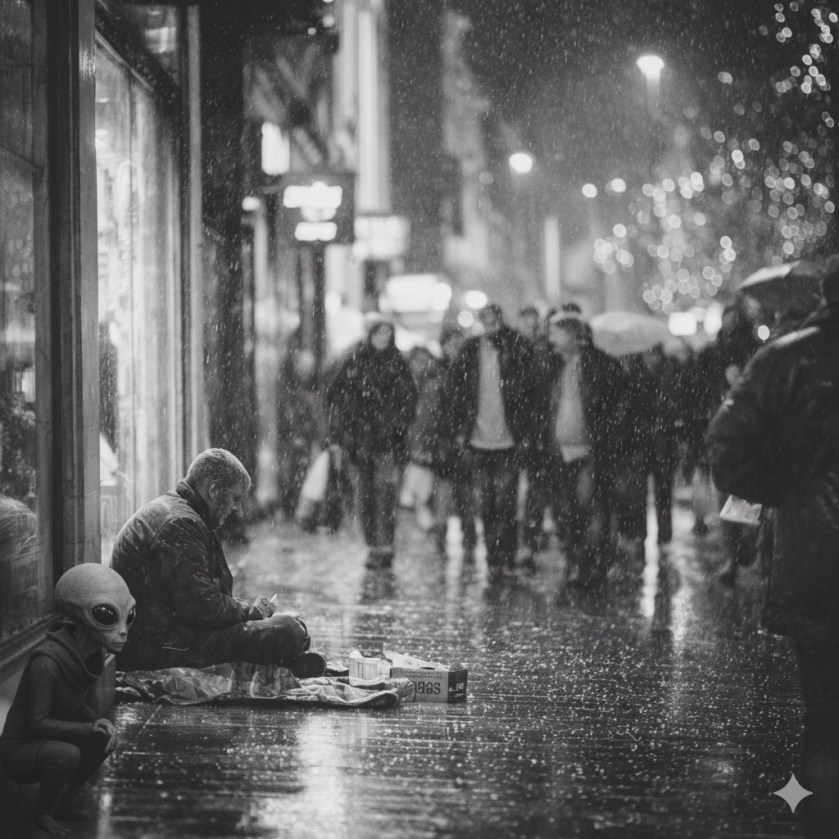
I took the original image from the story, ”The Puddle I’m Sitting In’ and put it into Gemini and asked it to add an alien, watching proceedings. It was able to do this without changing the original picture.
Call To Action
Have you got a story that you could enhance by adding in a completely different point of view? Let me know what you think of my experiment.


 The AI Grandad