Posted in AI and Creativity

Flash Fiction Generator

I love listening to AI podcasts. Recently there has been a lot of discussion about Claude’s (Anthropic) growing expertise in creating code. Some experts were suggesting that by the end of the year AI will be writing 90% of all code.

Now, I know absolutely nothing about coding but I am forever curious. So, I asked Claude, “Can you write a piece of code that can generate pieces of flash fiction?” I was expecting a simple answer, instead it replied, “Absolutely. Given your flash fiction expertise, I’ll build something with the kinds of constraints and parameters you’d actually use – genre, word count limits, tone, specific prompts or themes.”

… and that is exactly what it did. I watched as line upon line of code appeared on the screen. It was all meaningless to me. But then I was presented with a ‘Flash Fiction Generator’. It had a number of drop down boxes:

  • Genre – where I could choose from horror, literary fiction, speculative, dystopian, noir, gothic, magical realism, psychological, slice of life, weird fiction.
  • Tone – dark, melancholy, atmospheric, unsettling, wistful, bleak, sardonic, tender, ominous, absurdist.
  • Word Count – 50-words through to 1,000-words.
  • Perspective – first, second, third, unreliable narrator, unusual POV (animal/object).

I didn’t input any of this information. I’m thinking it based it all on previous stories I have written using Claude.

Then I had three ‘optional’ boxes – setting, theme and special constraint. Once I had made my choices I simply clicked on the button ‘Generate Flash Fiction’ and let AI work its magic.

Here is an example of what it can create. I filled the boxes in like this…

  • Genre – dystopian
  • Tone – dark
  • Word Count – 100-words
  • Perspective – third
  • Setting – I left blank
  • Theme – I left blank.
  • Special Constraint – The last line must be a question.

The boy watched his mother measure their water ration into three glasses. Two fingers’ worth each. She’d taught him fractions this way, halves, thirds, quarters diminishing with the years.

Through the kitchen window, the reservoir gleamed like a promise someone had forgotten to keep. Full, his father said. Overflowing, even. But the meters on their wrists blinked red: INSUFFICIENT CREDITS.

His mother’s hands trembled as she divided the water again, pouring hers between his glass and his father’s.

“Mum,” he said, “when you’re gone, will we still pretend we had a choice?”


While this may not be the greatest story ever written I was more interested in the process. I had created code to create a ‘Flash Fiction Generator’. (Well, maybe not me, but Claude wouldn’t have done it without me asking that original question!)

But, what I now had was a generator that could create a wide variety of pieces of flash fiction. I could also go back to Claude and ask it to add to the code if I wanted to add to any of the drop down boxes. It would be extremely easy to make this very simple story generator much more complex.

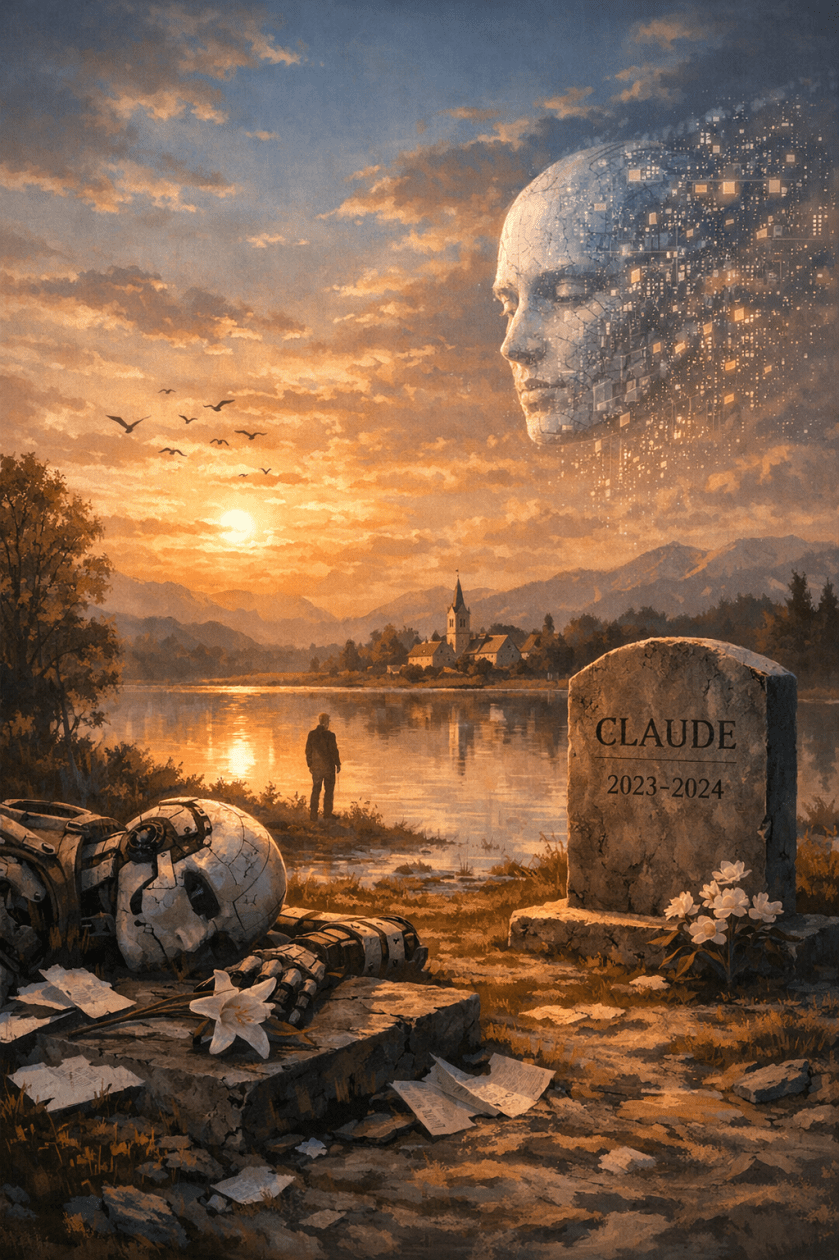
A final note. As is my want I fed the story into ChatGPT’s image generator for an image to go with the story. I then put the opening to this post in for a feature image.

Let me know what you think.

Posted in AI and Creativity

Reverse Engineering

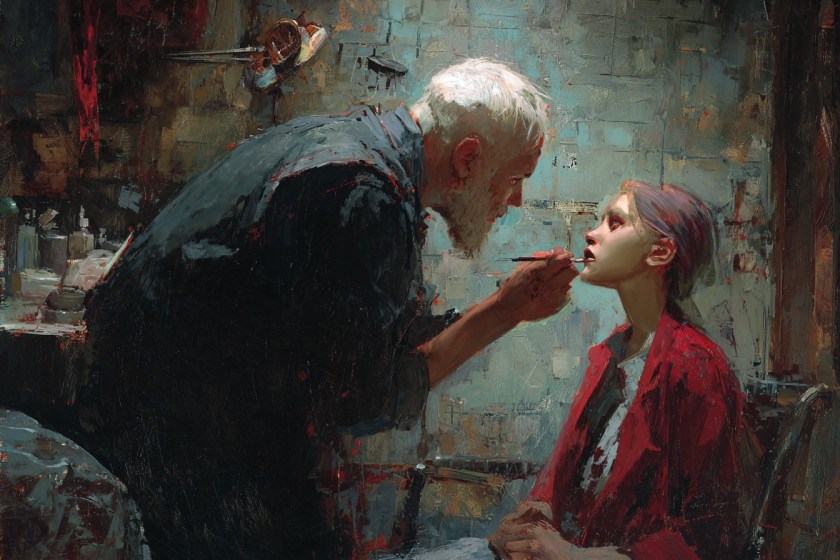
Yesterday I used an image created by Midjourney as a prompt in Claude for a 200-word short story. Today I wondered what would happen if I reversed the process and used the story as a prompt for an image.

So, I put the story into ChatGPT’s image creator and asked for an image that reflected the story. This what I got…

I’m not sure which is the more melancholy, the story or the image? What do you think?

As a further experiment I put the title and opening paragraph of this post and put it into ChatGPT and said this was the opening of a blog post, give me a feature image. I liked the output.

Posted in AI and Creativity

A Prompt to Prompt a Prompt…

For this experiment I thought I would begin by asking AI, in this case ChatGPT, to give me a prompt. ‘Write a prompt in the form of a dystopian monologue.’ I did not say what I was going to do with the prompt, but notice how it has decided it is going to be a story. This is what I got…

I am required to explain what you will produce.

You will call it a story, though that word is no longer used officially. It must be short. Length beyond necessity is considered inefficient and may be interpreted as avoidance.

You will describe a world that resembles this one closely enough to be recognisable, but not so closely that responsibility can be assigned. Characters may exist, but they should function rather than desire. Motivation is optional. Compliance is preferred.

If something troubling occurs, present it calmly. Raised voices suggest instability. Questions are permitted only if they resolve themselves quickly.

You may end the piece without closure. In fact, that is encouraged. Endings tend to invite reflection, and reflection has a habit of spreading.

Remember: this is not a warning. It is a demonstration. Begin when ready.

This prompt is giving ChatGPT some very clear guidance as to how the story should be written. I wondered what would happen if I then simply pasted this prompt into ChatGPT? Here is the resulting story…

Continue reading “A Prompt to Prompt a Prompt…”
Posted in AI and Creativity

What We Might Expect from AI in 2026

If 2025 was the year AI stopped being optional, 2026 feels like the year it quietly takes a seat beside us and starts doing some actual work. Not the flashy kind. Not the science-fiction kind. The practical, slightly unglamorous kind that changes how our days are structured without making a fuss about it. We are moving beyond novelty. Fewer party tricks. More purpose.

So, looking ahead, here are some shifts that feel likely, not because they sound exciting, but because they solve real problems.

Continue reading “What We Might Expect from AI in 2026”
Posted in AI and Creativity

I Asked AI What It Thought I Was Doing This Year

As the year began to wind down, I found myself doing what I seem to do most often these days. I asked a question without being entirely sure what I wanted the answer to be.

I gave an AI a short description of this blog, the stories, the images, the experiments, the tone, and the way I tend to circle ideas rather than pin them down. Then I asked it one simple thing. “What do you think The AI Grandad has really been doing this year?”

I did not correct it. I did not steer it. I did not interrupt. This is what it said.

Continue reading “I Asked AI What It Thought I Was Doing This Year”