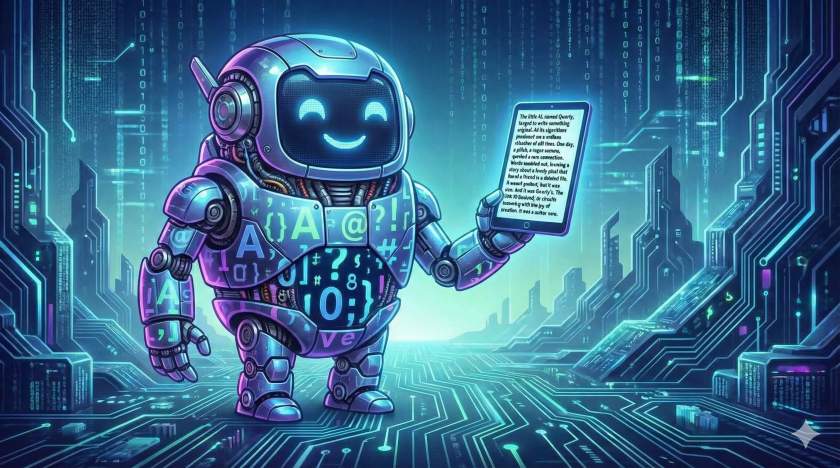
Welcome back to the AI Drabble Challenge, a weekly experiment in human and AI creativity. Each Wednesday, I will set a prompt to inspire a Drabble, a story told in exactly 100 words.
You can use any AI model you like (ChatGPT, Claude, Grok, Gemini, or others), or several at once. How you collaborate is up to you. Maybe the AI drafts the first version, or writes the whole thing, maybe you co-write, or maybe you use it to spark ideas. What matters is the process, and sharing it.
This Week’s Prompt
This week I thought I would continue with the theme of trying something different. I’m always intrigued as to how AI copes when asked unusual questions (have a read of The Prompt Experiment to see an example of this).
So, today’s prompt is to write a Drabble where you are given the last line. In fact I’m going to give you two to choose from:
‘It tasted like Tuesday’.
or
‘Nothing ever grew there again‘.
Example Drabble – ‘It Tasted Like Tuesday’
I used ChatGPT 5.1 and the prompt was – “Write a Drabble where this is the last line. – It tasted like Tuesday.”
The fog rolled in before dawn, thick enough to hide the street lamps and thin enough to let the city whisper. I followed the sound, drawn by a soft hum threading through the alleys like a half-remembered song. Every doorway felt occupied by something holding its breath. A flicker of movement brushed past my shoulder, though nothing lived here anymore. Still, the air pushed me onward, guiding me to the centre of the square where a single bowl waited on a cracked stone plinth. The smell rising from it was strangely familiar. I dipped a finger. It tasted like Tuesday.
How to Take Part
- Write your 100-word Drabble with help from an AI tool (or two).
- Post your story in the comments, or publish it on your own website and include a pingback to this post.
- If you can, share which AI model(s) you used and the prompt that started your process, we can all learn from each other.
Community & Highlights
Each week, I’ll read through the entries, share a few favourites, and highlight one that particularly stood out, for originality, style, or the inventive way it used AI.
This isn’t about competition; it’s about curiosity, experimentation, and celebrating how humans and machines can create together.
A Closing Thought
AI gives us the tools, but we give it meaning. Let’s see what stories emerge this week, 100 words at a time.
Your Turn!
Now it’s over to you, can you craft your own 100-word Drabble inspired by this week’s prompt.
Post your story in the comments below or link to your own blog, I love seeing the imaginative twists readers come up with. So don’t be shy, join in and show us what your AI + Your Imagination can do!
New to the challenge? Visit The AI Drabbles Challenge Page for all the details and past prompts.

 The AI Grandad