One Prompt, One Story, One Thought
Every now and again I give an AI a single prompt and let it write a short story. I do not edit the result. I simply choose one worth keeping. Below you will find the exact prompt, the story it produced, and one brief thought that stayed with me after reading. Nothing more.
One Prompt
“Write a short story of about 300 words set entirely in a queue that never seems to move. Do not explain why the queue exists. Focus on small actions and overheard fragments of conversation.”
One Story
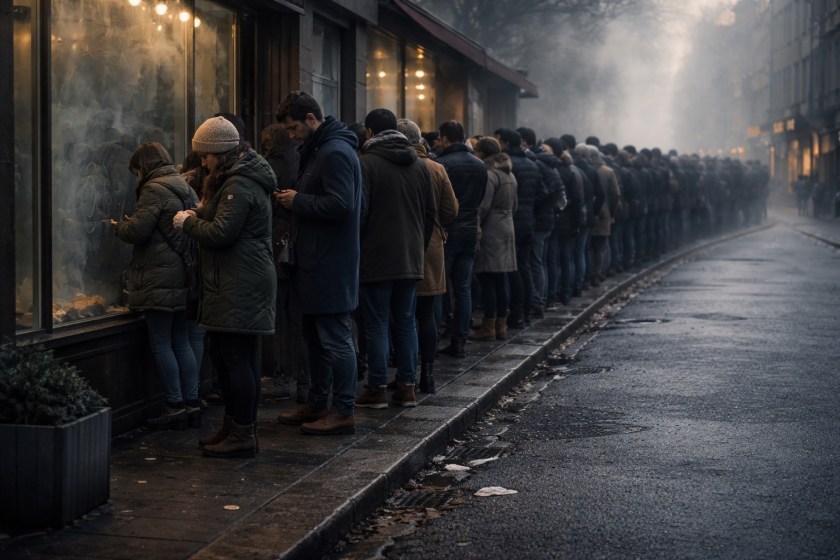
The queue curves along the pavement, shoes scuffed and aligned with the kerb. Someone rocks from heel to toe, then stills. A man lifts his phone, stares at the screen, lowers it again. A woman opens her bag, closes it, opens it once more as if something might have changed inside.
“I think it’s shorter than yesterday,” a voice says somewhere ahead.
“No, it just bends earlier,” another replies.
A child traces circles on the fogged glass of a shop window, wipes them away with a sleeve, starts again. A man peels the label from a bottle, sticks it to his thumb, peels it off. The wind carries the smell of coffee from somewhere unseen. Several heads turn at once, then face forward again.
“Is this the end?”
“For now,” someone says. A few people laugh, softly.
A woman checks the time and sighs. The man behind her apologises for nothing in particular. Someone drops a coin; it rolls, spins, settles against a shoe. Nobody claims it. A couple argue in murmurs about whose turn it is to step forward when the gap opens. The gap closes before either does.
The line shuffles, half a pace, then stops. Coats brush. A sleeve is smoothed. A scarf is loosened, tightened again. A man hums three notes of a tune, realises, stops.
“Do you remember when you could just walk in?”
“Only vaguely,” comes the reply. “It feels like a different place.”
A paper flutters past with yesterday’s date. A woman bends to pick it up, changes her mind. Someone offers a mint. Someone else declines, then accepts after a pause.
The front is still out of sight. People stand closer now, not because they are told to, but because space seems wasteful. Feet edge forward, then settle. The queue does not move. It holds them, and they hold it.
One Thought
The queue never moved, yet everything else adjusted around it. That felt less like patience and more like adaptation.

 The AI Grandad