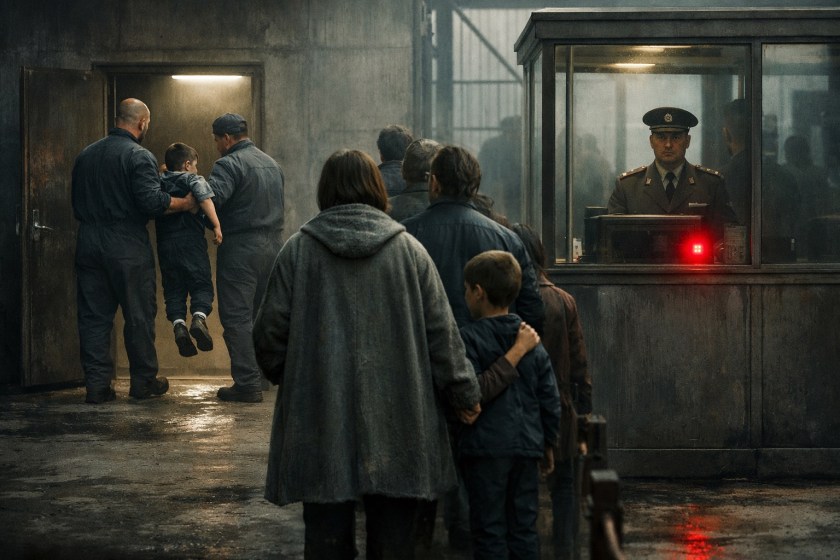
The queue moved one pace forward every seventeen minutes. I counted. Always seventeen. Never sixteen, never eighteen. The woman in front of me wore a grey coat too large for her frame; the sleeves swallowed her hands. She kept them tucked inside anyway.
A child, perhaps seven, stood two places ahead. His mother held his wrist so tightly the skin around her fingers turned white. He did not cry. None of them cried any longer. The sound had been removed from them before they reached the gate.
At the front the officer’s booth stood glass on three sides. We could see everything. The officer wore no expression. His uniform was pressed, the creases sharp enough to draw blood. He asked questions in a voice that carried on the wind even to where I stood.
Name. Age. Occupation before. Reason for travel.
The answers never varied much. A name, a number, a factory code or a domestic designation, then the same three words: Seeking reassignment. The officer tapped something into the terminal. A green light flashed once. The barrier lifted. The person stepped through without turning.
Sometimes the light stayed red.When it did, two attendants appeared from the side doors. Always the same two: one tall, one short, both in unmarked coveralls. They took the person by the elbows. No struggle. The person allowed himself to be led away through the unmarked door on the left. The door closed without sound.
The queue moved forward again.Seventeen minutes.
Today the child reached the booth. His mother released his wrist only when the officer nodded. The boy stepped onto the low wooden block kept there for the smaller ones. He recited his details in a voice too old for his body.
Name. Age. Occupation before. The officer asked the final question.Reason for travel.The boy said nothing.
His mother, three paces behind now, opened her mouth but made no sound. The officer waited exactly seven seconds. Then he pressed the button.Red light.The attendants came. The tall one lifted the boy under the arms. The short one took his ankles. They carried him like a parcel through the left-hand door.
The mother remained where she was. She did not move forward. She did not step back. She stood exactly in the place her son had occupied, staring at the closed door.The queue shifted. Seventeen minutes passed. The officer called the next name.
The mother stayed.I watched her coat sleeves tremble once, then still. Her hands never emerged.The line continued. Another green light. Another red. Another set of coveralls disappearing through the unmarked door.
Seventeen minutes.I counted.
Generated by AI. Selected by me.
 The AI Grandad