I was recently staying in a hotel where the notepads by the side of the bed each had a motivational quote at the bottom of the page. It got me thinking, “Could AI write a story based on one of these prompts?” The answer – of course it could! i
The quote I chose was, “Continuous improvement s better than delayed perfection.” I gave Claude this quote, “I want you to use this quote as a prompt or idea for a sinister 200 word dystopian piece of flash fiction. Set in Manchester. ‘Continuous improvement s better than delayed perfection’.”
Here is the story it gave me…
Personal Best
My daughter’s score dropped by 0.003 overnight.
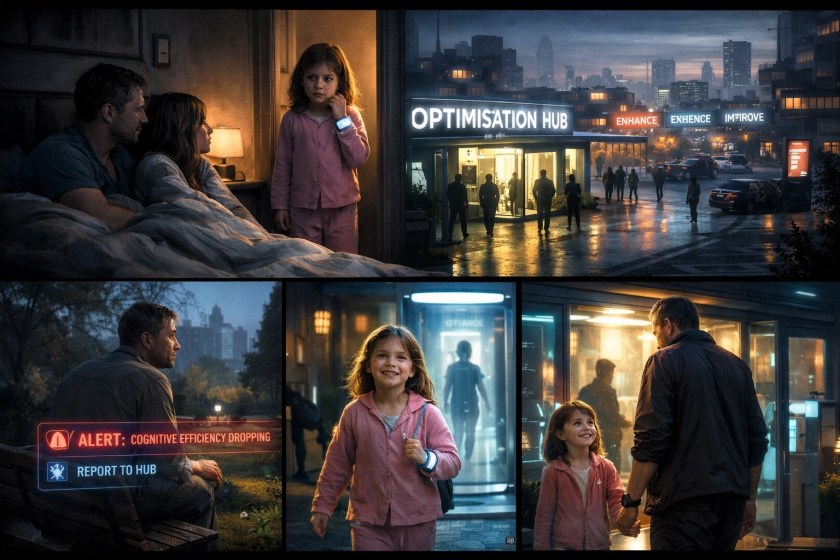
The notification woke us at 4am, that soft, insistent chime from the monitor on her wrist. She’s seven. She stood in our bedroom doorway, crying, asking what she’d done wrong. Nothing, I wanted to say. You’ve done nothing wrong. You’re perfect. But we don’t use that word anymore.
The Optimisation Hubs line every street in Salford now. Twenty-four hours, no appointment necessary. You walk in with your deficiencies, walk out marginally improved. Sleep efficiency. Attention span. Empathy metrics. All adjustable. All improvable.
My daughter went in at 6am. Came out humming, her score restored, her tears forgotten. She’s been in fourteen times this year.
I remember when children just were. Before the metrics, before the monitors. My mother let me be bored. Let me fail. Let me sit in the garden doing absolutely nothing, becoming no one in particular.
Stagnation, they’d call it now.
My own score’s been slipping. I’ve started thinking about the old days too often. Unproductive cognition. The Hub sends gentle reminders—helpful nudges, encouraging incremental correction. My daughter watches me with her bright, optimised eyes.
“Daddy,” she says. “You should go. You’d feel so much better.”
She’s right, probably. Everyone feels better, after.
But Why?
What I found even more interesting than the story was its thinking behind the story. I’d asked Claude, “Why does this story fit the quote, explain your thinking behind it.” And it did…
The quote’s usually meant as reassurance, don’t obsess over getting things perfect, just keep iterating, shipping, improving. It’s a productivity mantra. Agile development. Kaizen. All very sensible.
But there’s something sinister lurking underneath if you push it far enough. If continuous improvement is better, then perfection isn’t just delayed, it’s undesirable. An endpoint. A stopping point. And if stopping is bad, then you must never be finished. Never be enough.
So the story takes that to its conclusion: a world where perfection is a forbidden concept, where children are monitored for microscopic fluctuations in their “score” and corrected immediately. A 0.003 drop is meaningless in absolute terms, but in a system built on continuous improvement, any backsliding, however tiny, is intolerable.
The daughter’s been “optimised” fourteen times in a year. She’s seven. She’ll never be permitted to simply be a child, to exist without measurement, because that would be stagnation. The narrator remembers boredom, failure, doing nothing, all now pathologised.
And the gentleness is the worst part. No one’s forcing anyone. It’s just… expected. Encouraged. Normal. The daughter has already internalised it so completely she’s nudging her own father toward correction.
The horror isn’t the improvement. It’s the continuous. The never-ending. The quiet abolition of “enough.”
A Final Thought
I asked Claude to give me its thinking behind the story it had written, but AI chatbots can’t ‘think’ – can they?
Let me know what you think.
 The AI Grandad