There’s a moment, every so often, when history quietly changes direction and most of us don’t notice because we’re too busy doing other things. The printing press began as a technical curiosity long before it became a cultural turning point. Electricity, too, slipped into daily life one room at a time. When the internet appeared, most of us treated it as a mild curiosity. Something interesting, certainly, but hardly the force that would reshape how we live, work and tell stories.The world rarely recognises a revolution at the moment it begins. Most of us only understand what changed when we look back.
Continue reading “The Creative Renaissance No One Saw Coming (And Why It’s Just Getting Started)”Tag: Technology and Ageing

Is Everything Made by AI Really Just “Slop”?
I keep hearing the phrase “AI slop” tossed around with the sort of relish usually reserved for complaining about school dinners or the state of modern television. It’s become one of those instant dismissals, a way to wrinkle one’s nose and wave away anything that happens to have an algorithm involved.
But is it really fair? Is everything touched by AI automatically destined for the creative compost heap? Personally, I don’t buy it, and the more I talk to people about it, the more it feels like the term tells us far more about the speaker than the work itself.
Continue reading “Is Everything Made by AI Really Just “Slop”?”Wandering With Words: My First Experiments With AI-Written Haibun
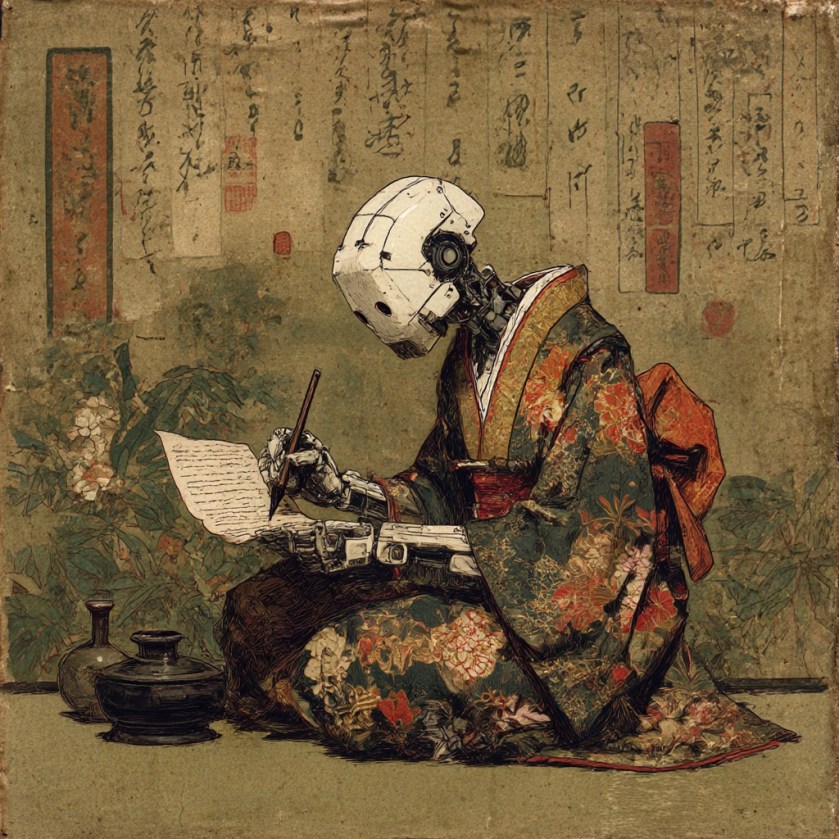
A haibun is one of those lovely poetic inventions that sneaks up on you. It is part story, part poem, and entirely its own creature. It comes from 17th-century Japan, made famous by the wandering poet Bashō, who mixed gentle prose observations with small, luminous haiku.
In modern hands, it feels surprisingly fresh: reflective, compact, and a bit like opening a window between the everyday and the poetic. No wonder it appeals to me. I’ve always believed curiosity keeps us young, and haibun offer the perfect excuse to wander, wonder, and watch what AI does with a few well-aimed prompts.
Continue reading “Wandering With Words: My First Experiments With AI-Written Haibun”AI Creativity Myths Busted
The light, chatty truth behind what AI can, and can’t, really do.
There’s a lot of chatter out there about artificial intelligence and creativity.
Depending on who you ask, AI is either a genius, a fraud, or a polite little assistant who can’t draw hands.
So today I thought I’d tackle a few of the biggest myths about AI and creativity, the ones that seem to cause the most panic and the loudest pub arguments. Don’t worry, this isn’t a lecture. Think of it as a chat over a cuppa about what really happens when humans and algorithms start co-creating.
Continue reading “AI Creativity Myths Busted”The 10-Second Curiosity Rule
If you’re puzzled by AI for more than ten seconds, ask it why, not how.
When I first started experimenting with AI, I treated it like a tricky gadget I couldn’t quite figure out. I’d type a prompt, get an odd or unhelpful reply, and then immediately start searching online for “how to fix it.” Half the time I’d end up buried in articles about neural networks, transformer models and training data, interesting, yes, but about as helpful as reading a car’s engineering manual when all you want to do is drive.
Over time, I realised something simple: AI doesn’t reward those who understand every detail of how it works, it rewards those who stay curious. Every mistake, every odd answer, every unexpected twist in a conversation is an opportunity to ask why rather than how.
That’s how the 10-Second Curiosity Rule began. It came from one of those slightly exasperating moments when ChatGPT gave me an answer that made no sense at all. My first instinct was to sigh and close the laptop. But I stopped myself, took a breath, counted to ten, and asked, “Why did you say that?”
Continue reading “The 10-Second Curiosity Rule”