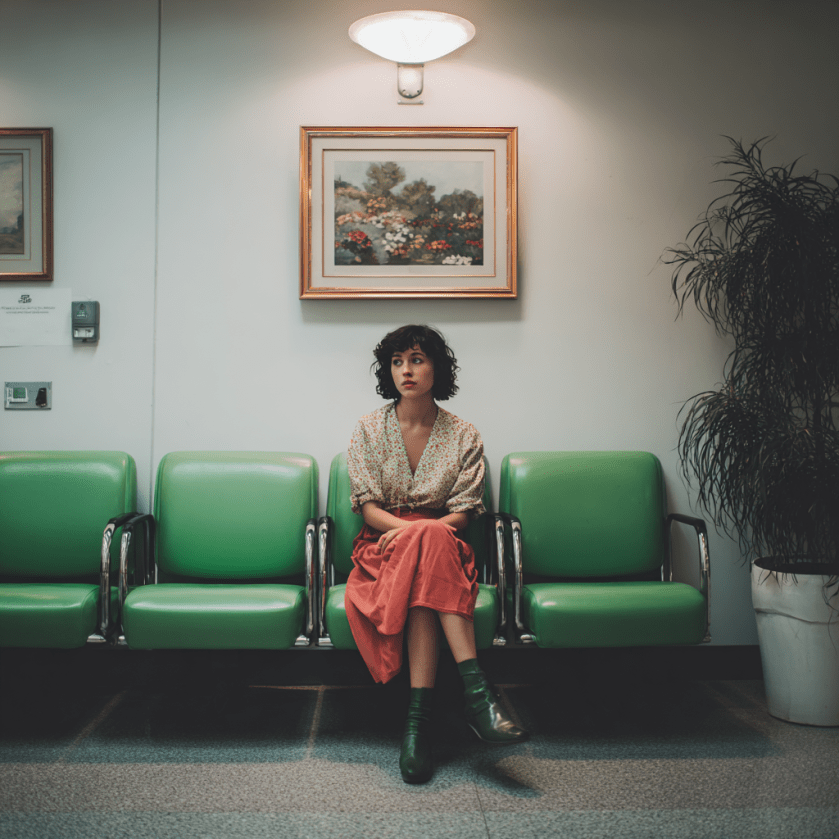
The chair had become familiar in a way Sarah never wanted. Green vinyl, cracked at the seams, with a spring that pressed against her left thigh if she sat too far back. She’d learned to perch forward, elbows on knees, watching the second hand crawl around the institutional clock on the opposite wall.
Three months of Tuesdays had taught her the rhythm of this place. The coffee machine gurgled at 2:15. The nurse with the grey braid always hummed something unrecognisable. The fluorescent light above the reception desk flickered exactly twice before steadying itself.
Michael had laughed when she first told him she was counting these things. “My brilliant analyst,” he’d said, touching her cheek with those long pianist fingers. “Always looking for patterns.” That was before, when his hands were steady and his eyes bright, when waiting rooms were abstract concepts attached to other people’s lives.
Now she knew waiting rooms were where love transformed. Not diminished, transformed. It shed its decorative elements, the candlelit dinners and weekend trips, the easy affection of unburdened days. What remained was something more essential and more frightening: the choice to stay when staying required everything.
An elderly man shuffled past, his wife’s hand tucked into the crook of his elbow. Sarah had seen them before, every Tuesday at 2:30, moving through the hallway like dancers performing a decades-old choreography. The wife always wore lipstick. The husband always held the door. They never spoke, but something in their silence seemed fuller than most conversations.
Sarah’s phone buzzed. Her sister: Thinking of you. Call me later? She would, probably. She’d say the same things she said every week. Yes, the doctors were optimistic. No, they didn’t know anything definite yet. Yes, she was fine, really, she was fine. The lies of protection had become their own kind of truth. She was fine in the way that people learn to be fine, the way trees grow around wounds, incorporating damage into their very structure.
The door opened and Michael emerged, leaning slightly on the nurse’s arm. His smile, when he saw her, was the same smile that had first caught her attention in that bookstore five years ago, genuine, slightly lopsided, lighting his whole face despite the grey pallor beneath it. Sarah felt her chest constrict with a love so fierce it bordered on rage. Rage at cells that multiplied without permission, at uncertainty that stretched forward like an endless corridor, at her own helplessness before forces she couldn’t analyse or control or fix.
“Ready?” he asked, as if they were leaving a theatre or a friend’s dinner party.
“Ready,” she said, standing, taking his free arm.
In the parking lot, November wind scattered leaves across the asphalt. Michael paused to watch them, and Sarah waited, understanding this was part of their new choreography too, these moments when he stopped to observe things he might have walked past before. A leaf’s fall. A bird’s call. The particular quality of afternoon light.
“I was thinking,” he said, still watching the leaves, “we should plant tulip bulbs when we get home. For spring.”
Spring. The word hung between them, fragile and defiant. An assertion of future tense. A refusal to concede to probability.
Sarah felt something shift in her chest, that tight knot of fear loosening just slightly. Not disappearing, it would never disappear, but making room for something else. Hope, perhaps, though not the naive kind. The kind that plants bulbs in November without guarantees, that shows up every Tuesday, that learns the rhythm of waiting rooms and keeps choosing presence over protection.
“Yes,” she said, squeezing his arm. “Let’s plant tulips.”
They walked toward the car, two figures against the grey afternoon, carrying their uncertainty like a shared burden, their hope like a shared rebellion, their love like the only truth that mattered.
Discover more from The AI Grandad
Subscribe to get the latest posts sent to your email.


