There’s a moment, every so often, when history quietly changes direction and most of us don’t notice because we’re too busy doing other things. The printing press began as a technical curiosity long before it became a cultural turning point. Electricity, too, slipped into daily life one room at a time. When the internet appeared, most of us treated it as a mild curiosity. Something interesting, certainly, but hardly the force that would reshape how we live, work and tell stories.The world rarely recognises a revolution at the moment it begins. Most of us only understand what changed when we look back.
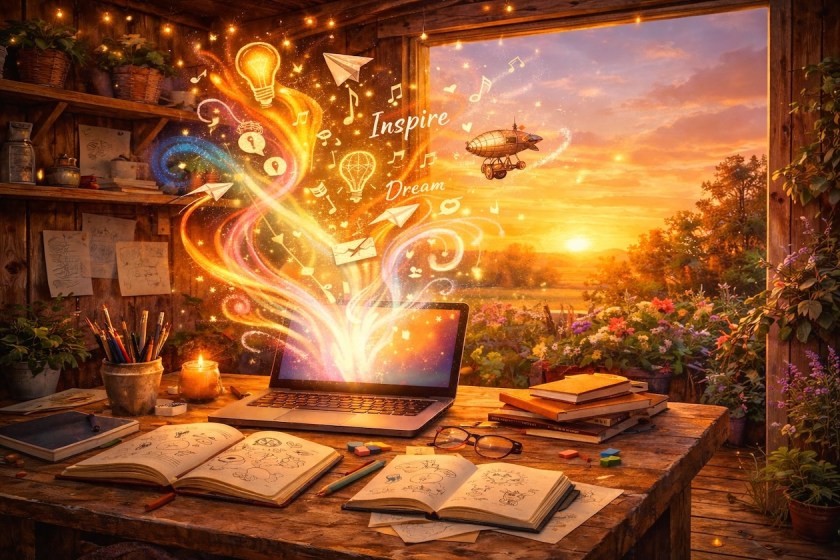
And now, as I sit in my little garden shed surrounded by a jumble of notebooks, old pens that long ago gave up the ghost, and the faint whiff of damp wood, I’m convinced we’re living through one of those moments again. Only this time, the shift is happening in the world of creativity, not with a thundering declaration, but with a gentle, persistent nudge.
We are in a creative renaissance. A real one. Not the marketing kind where a brand claims it has “reinvented creativity” because it changed its logo. Something deeper, stranger, and far more exciting is unfolding. Oddly enough, most people don’t seem to have spotted it yet. They’re still arguing about whether AI is cheating, or whether digital art is “real.
Meanwhile the artists, the curious tinkerers, the dabblers, the retirees rediscovering their spark, the teenagers rewriting their futures after school, the storytellers who thought the well had run dry, they’re quietly making more than ever before.
And I think it’s time we stopped whispering about it and said it plainly: We’ve entered a new era of creativity, and, if we’re not careful, we will miss it.
The Renaissance Didn’t Arrive With Trumpets, It Arrived With Prompts
If we imagine a renaissance, most of us picture a grand unveiling. Michelangelo stepping out from behind a marble block, covered in dust but triumphant. Shakespeare dashing across the stage, quill in hand, muttering asides about iambic pentameter. The actual Renaissance, of course, was nothing like that. It wasn’t a single explosion but a slow, cumulative bloom, one idea leading to another, like dominoes falling in slow motion.
This new renaissance came in even more quietly. It arrived not with sonnets or sculptures, but with strange, tiny text boxes labelled “prompt”. You type a sentence into one, something simple, something curious, maybe even something ridiculous, and the machine responds. A poem. A story. A song. An image. A short piece of music.
Most people shrugged. “Just a toy.” But some of us leaned in. Because to people who love making things, stories, pictures, ideas, odd little worlds you’d never admit to at a dinner party, this was a kind of magic. Not the magic of waving a wand and the thing appears fully formed. That’s never been creativity. Real magic is the spark that leaps between two different energies: human imagination and unexpected possibility. Prompts, as humble as they look, are simply the newest spark.
Before long the tools multiplied. Story generators. Image models. Voice engines. Music creators. Video generators. Tools that analyse your messy first drafts and make gentle suggestions. Tools that offer you alternatives when you’re stuck. Tools that listen to your creative heartbeat and whisper, “What if you tried it this way?”
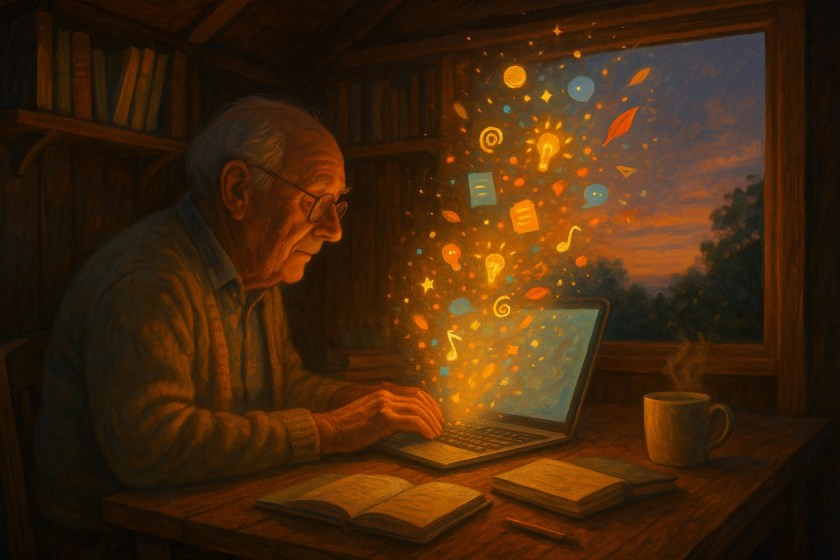
For people like me, a retired headteacher who never expected to spend his seventies running YouTube channels, crafting crime podcasts, and experimenting with sinister sci-fi flash fiction, this is a renaissance in the truest sense. An unexpected return of creative energy. A reawakening. A rebirth. And I’m far from alone.
The Gatekeepers Have Lost Their Keys (And Most Don’t Know It Yet)
In the old world of creativity, and by “old world” I mean, well, two decades ago, making things required permission. If you wanted a book, you needed a publisher. If you wanted to compose something, you needed years of musical training. If you wanted to illustrate your own story, you needed talent, or someone on Fiverr who might eventually understand what it is you really wanted. So many people simply didn’t make anything at all. They carried creative urges around like old receipts in a coat pocket, the kind you mean to sort through but never quite do.
AI didn’t simply open the doors. It blew the walls off. Suddenly, you didn’t need to be “good enough” to begin. Creativity became something you could do now, today, this minute. It became something you could play with rather than earning the right to attempt. A whole generation of people, from 14-year-olds to 75-year-olds, discovered that the blank page no longer had to be an enemy. It could be a conversation. A collaboration. A spark.
This is the renaissance most commentators are missing. They’re busy worrying about whether machines will take jobs or whether AI art counts as “real art”, while millions of ordinary humans are quietly experiencing something extraordinary: the removal of fear. If fear is removed from creativity… you’ll need to brace yourself. Because humans become astonishingly prolific when they stop being afraid.
The Return of Amateur Wonder
One of the great tragedies of creative culture over the last century was that amateurs were quietly pushed aside. Not deliberately, society simply became obsessed with professionalism. “Are you good enough?” became the great unspoken test. Even hobbies began to demand expertise. You couldn’t simply enjoy painting; you had to be a “painter”. You couldn’t doodle; you were told to take a class. You couldn’t write your own poem unless you studied form and meter, or risked being told you were doing it wrong.
The amateur spirit, messy, joyful, curious, fearless, withered. But now? It’s sprinting back with muddy boots and a grin. AI rewards the amateur mindset beautifully. You don’t need a grand plan. You don’t need years of skill. You simply need curiosity. You can dabble, play, remix, push, stretch, make a glorious mess and wipe it clean.
Curiosity is the new talent.
Playfulness is the new skill.
Taste is the new craft.
AI doesn’t delete the need for taste, by the way, it enhances it. Anyone can create an image; not everyone can choose the image that carries meaning. Anyone can generate a story draft; not everyone can sense which version resonates. The amateur renaissance isn’t about low quality, quite the opposite. It’s about low fear. And low fear leads to enormous freedom.
Creativity Has Become a Daily Practice, Not a Distant Dream
Once upon a time it took months to write a book, days to draw a single illustration, or years to learn how to compose music. Now many creatives produce something every day, a poem before breakfast, an image while the kettle boils, a strange experimental piece of flash fiction while waiting for the washing machine to finish its spin cycle. The technology didn’t rush in to replace creative practice. It rushed in to accelerate it.
I write more stories now in a fortnight than I used to manage in a year. Not because I’m cheating, but because the bottlenecks have gone. The friction is lighter. The energy flows. When inspiration hits, or even when it doesn’t, I can sit down, open a prompt, and within minutes I’m in the thick of a new world.
And the joy of daily creativity is enormous. It’s like brushing the dust off your imagination each morning. You feel younger, more alive, more connected to that spark you vaguely remember having at school when you scribbled stories about dragons on the back of your exercise book.
The renaissance isn’t about speed, though that plays a part. It’s about momentum. Creativity loves movement. It hates waiting for permission. AI lets you move.
The Renaissance Isn’t Just About Making Things, It’s About Sharing Them
Once upon a time you wrote a poem or painted a watercolour and it sat quietly in a drawer, occasionally shown to a sibling who smiled politely and asked whether the blue smudge was a hill or a cloud. Now creative work finds an audience instantly. You post it. Someone sees it. They comment. The loop of creation tightens.
This sharing has birthed communities in every niche you can imagine. AI writers, AI poets, AI image creators, AI musicians, AI quirk-experimenters. Forum threads. Discord servers. Twitter (X) threads. Little glimmering pockets of creativity where people cheer one another on.
But the most interesting thing isn’t the speed or scale, it’s the tone. These communities are generous, curious, often playful. Gone is the intense competitiveness of the old world, where everyone quietly wondered whether the person next to them had a better chance of getting published. Now we’re dabbling together. Learning together. Prompting together. Sometimes even messing up together.
The renaissance is communal. A shared adventure. A shared playground. And the playground keeps getting bigger.
AI Isn’t Replacing Human Creativity, It’s Revealing It
The great misunderstanding about AI is that it creates meaning. It doesn’t. It creates material. The meaning is ours. What we choose to make tells the world who we are. What we choose to keep tells us who we want to be. The prompts we write, those strange little sentences typed into a box, reveal our obsessions, memories, longings, fears, hopes. AI is a mirror, not a magician. It reflects the shape of our imagination. Sometimes more clearly than we expect.
I’ve noticed that when I prompt an AI to write a sinister sci-fi flash story, I’m not simply making the machine create darkness. I’m exploring something of my own interest in the eerie, the uncanny, the slightly off-kilter. When I ask it to help me write a cosy mystery set in a seaside village, I’m stepping back into the landscapes of childhood holidays, the places where mystery felt enticing rather than frightening.
The machine is not the source. The machine is the echo. The source is us. And that is why the renaissance is so remarkable. Millions of people are discovering, perhaps for the first time since they were children, what they actually care about creatively. The technology simply offers a faster route back to themselves.
We’re Not at the Peak, We’re at the Beginning
If this is a renaissance, it isn’t the end of one. It’s the first week of the first month of the first decade. What comes next will be wilder. We’ll see stories that shift depending on who reads them. Characters who remember you from book to book. Poetry that adjusts its rhythm to your mood. Music that evolves as your day unfolds. Visual storytelling where your choices influence the world.
This isn’t science fiction, it’s appearing already in small pockets, like seedlings breaking through the soil. People tend to miss seedlings. They look too small to matter. But anyone who’s ever planted a garden knows where the real magic happens. It happens quietly, before anyone is paying attention. That’s where we are now: in the tender, early stages of something enormous.
The creative renaissance won’t be defined by machines replacing artists, but by artists expanding what art can be. It won’t be a story of loss, but of abundance; not a tale of scarcity, but of possibility.
And the best part? You don’t need permission to join it. You don’t need talent, qualifications, or endorsements. You don’t need the right connections or the right tools. You just need to start. Because the renaissance is happening whether the world notices or not. And some of us, sitting in garden sheds or bedrooms or tiny flats or cafés, have already stepped into it, almost by accident, simply because the spark felt too irresistible to ignore.
I suspect history will look back at this era and wonder why we weren’t shouting from the rooftops. Why we didn’t recognise the shift sooner. Why we didn’t realise that this was the moment creativity stopped belonging to the few and began belonging to everyone.
The Renaissance nobody expected is underway. And the best bits, the wild bits, the experimental bits, the bits that make you grin like a child pressing your first paint-smeared handprint on a wall, haven’t even happened yet. It’s just getting started. And I, for one, can’t wait to see what we all make next.
Call to Thought
So here’s my question: what spark of creativity are you carrying into this new renaissance, and where might it take you next?
About The AI Grandad
Find out more about The AI Grandad on:
YouTube – The AI Grandad
X – The AI Grandad
Facebook – Mike Jackson – The AI Grandad
What do you think AI creativity tells us about ourselves?
Share your thoughts in the comments, I love hearing from curious minds!
Discover more from The AI Grandad
Subscribe to get the latest posts sent to your email.

 The AI Grandad