Today I have been exploring ‘Oulipo’, which is short for Ouvroir de littérature potentielle, or “workshop of potential literature”. This was a French literary movement founded in 1960 by writer Raymond Queneau and mathematician François Le Lionnais. The group believed that creative constraints, far from limiting a writer, could unlock new possibilities that free writing would never discover.
Their techniques range from the famous to the fiendishly obscure. The lipogram excludes a particular letter entirely, Georges Perec wrote a whole novel, La Disparition, without using the letter E.
N+7 replaces every noun in a text with the noun seven entries later in a dictionary.
Snowball poems add one letter per word.
And then there are preverbs: sentences constructed by splicing together the first half of one proverb with the second half of another, producing something that sounds almost wise. A rolling stone makes Jack a dull boy. Too many cooks are a long time coming. The results are unsettling in the way that sense collapsing into nonsense always is.
For writers experimenting with AI, Oulipo feels oddly prophetic. Constraint-based prompting produces precisely the pressurised, unexpected writing the Oulipians were after. The machine thrives under rules.
They would probably have had a lot to say about that.
Preverbs
I asked Claude to create some ‘Preverbs’ for me. I found these particularly fascinating:
Power corrupts” + “Necessity is the mother of invention”
- Power is the mother of invention
- Necessity corrupts
“The apple never falls far from the tree” + “Justice is blind”
- The apple never falls far from the blind
- Justice is the tree
“Give a man a fish and you feed him for a day” + “The nail that sticks up gets hammered down”
- Give a man a fish and you hammer him down
- The nail that sticks up feeds him for a day
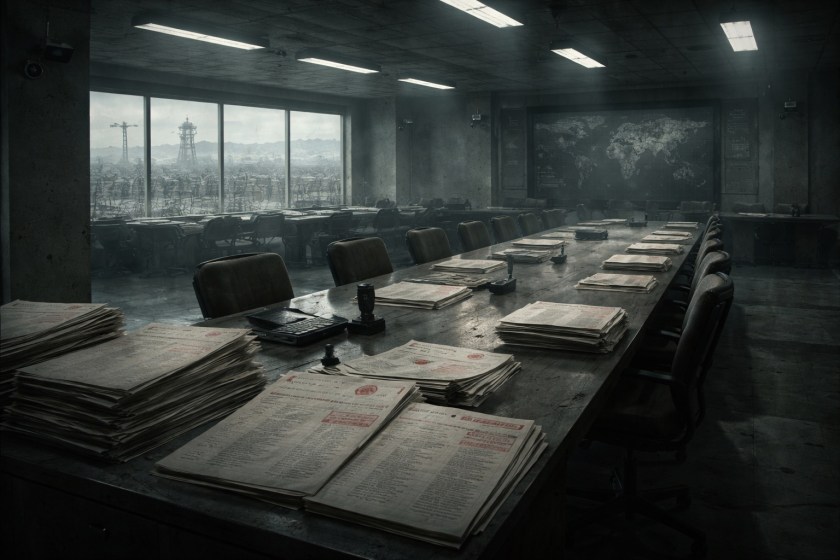
I then asked Claude to write me two dystopian monologues, one on the theme of, ‘Power is the mother of invention’ and the other on the theme of, ‘Necessity corrupts’. This is what it gave me…
The Mother of All Things
They told you necessity was the mother of invention. Sweet, isn’t it? Necessity. As if the great leaps forward in human ingenuity came from hunger, from want, from some communal striving toward a better world. They lied.
Look at what we actually built. The printing press to control the narrative. The census to count what we owned. The photograph to identify those who ran. The telephone to listen. The algorithm to predict. Each invention presented to you as liberation, each one a tighter link in the same chain.
Necessity didn’t build the surveillance tower. Power did. Power looked down at the long dark fields of human behaviour and said: I want to see further. And so the lens was ground. Power looked at the noise of dissent and said: I want silence.And so the tools were made. Not because someone was hungry. Because someone was watching, and watching was not enough.
We don’t apologise for this. Why would we? You built your little comforts on the same principle. Your locks. Your fences. Your passwords. Every small act of protection is power asserting itself over chaos. You understand us more than you admit.
The difference is ambition. We looked at everything you were and asked: what would make this easier to hold? And then we got to work. You called it progress. We called it Tuesday.
The Necessary Things
We didn’t start with cruelty. That’s what you need to understand. Cruelty is expensive, inefficient, and draws attention. We started, as all reasonable administrations do, with necessity.
The first list was necessary. Certain individuals posed a documented risk to supply chain stability. You understood that. Most of you signed the acknowledgement forms without reading them, which was also necessary, and which told us a great deal.
The camps were necessary. Not as punishment, we were very clear about this in the literature, but as a logistical response to processing volume. When the numbers exceed the infrastructure, you build more infrastructure. Any reasonable person would agree.
The children were separated for their own protection. Necessary. The broadcasts were adjusted for clarity and morale. Necessary. The history was revised to reduce unnecessary distress in the population. You cannot grieve what you don’t remember. This too was a kindness.
Here is what corruption actually looks like: it looks like a Tuesday morning meeting where no one raises their hand. It looks like a signature. It looks like a woman who used to read poetry deciding that the poetry archive requires rationalisation. It looks like you, specifically, choosing the easier interpretation of an ambiguous instruction.
We didn’t corrupt you. Necessity did. We simply created the conditions. Every society gets the atrocities its paperwork permits. Yours permitted quite a lot, as it turns out. We found that necessary too.
Closing Thoughts
Raymond Queneau and François Le Lionnais wanted to find out what language does when you corner it. So do I. The difference is I’ve got a machine doing the cornering. The language, it turns out, still knows how to bite.
Discover more from The AI Grandad
Subscribe to get the latest posts sent to your email.

 The AI Grandad