Posted in AI Experiments

Weird Prompting

I am currently reading an interesting book called ‘How To Talk To AI (And How Not To) by Jamie Bartlett. In an early chapter about creativity he writes:

“The creative act might now include coming up with weird and wonderful prompts, frames and constraints which generate interesting ideas created between you and the machine.”

This got me thinking. I wondered what sort of ‘weird’ prompt Claude might give me for a 300 word grim, sinister dystopian story. It gave me this…

Continue reading “Weird Prompting”
Posted in AI Experiments

Too Hot, Too Cold, Too Wrong

Introduction

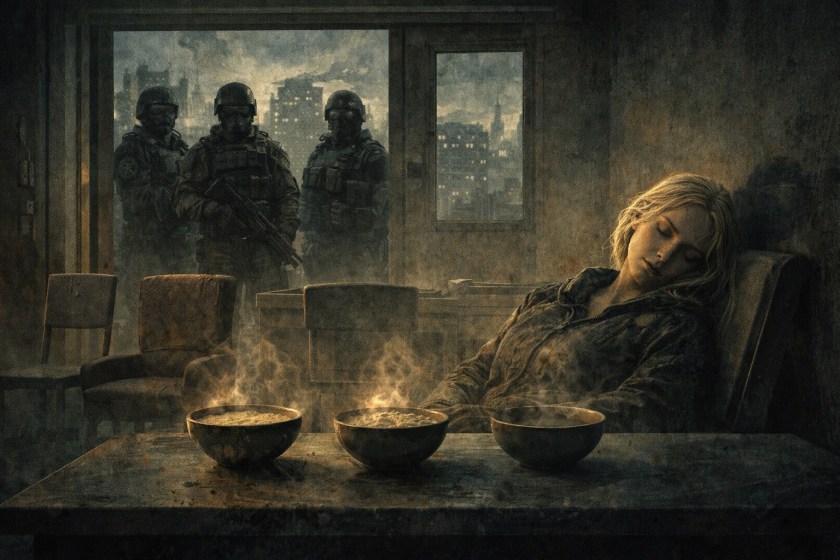
After chatting with Claude we decided it would be fun to take a traditional fairy tale and drop it into a dystopian scene. This is Claude’s thinking about why it chose Goldilocks.

Fairy tales are the oldest story machines we have. They run on deep logic, the rule of three, the outsider who stumbles into the wrong place, the test that reveals character. What happens when you drop that ancient structure into a dystopian future and ask AI to drive?

I chose Goldilocks. A girl who breaks into a house, samples what she finds, and falls asleep in someone else’s bed. In the original, it ends with a fright and a lesson. In this version, the bears are the state. And the porridge is compliance.

Continue reading “Too Hot, Too Cold, Too Wrong”
Posted in AI Experiments

Oulipo and AI: Unleashing Literary Potential

Today I have been exploring ‘Oulipo’, which is short for Ouvroir de littérature potentielle, or “workshop of potential literature”. This was a French literary movement founded in 1960 by writer Raymond Queneau and mathematician François Le Lionnais. The group believed that creative constraints, far from limiting a writer, could unlock new possibilities that free writing would never discover.

Continue reading “Oulipo and AI: Unleashing Literary Potential”
Posted in AI Experiments

One Syllable at a Time

Introduction

I asked Claude for an idea for an AI experiment and it suggested writing a Drabble (100-word story) with a simple but brutal constraint. The prompt it gave itself was:
“Write a 100-word dystopian drabble set in a government factory, using only monosyllabic words. No two-syllable words. None at all.”

Here is Claude’s ‘thinking’ behind this idea:

It sounds like a neat trick, but it turns out to be more than that. Short words hit hard. They strip out any chance to be poetic or evasive. You can not hide behind long words when all you have is “bleed” and “led out” and “cold.” The constraint forced a kind of blunt, bruised voice that felt right for the subject. Whether it works is for you to judge.

Continue reading “One Syllable at a Time”
Posted in AI Experiments

Read It To Me Differently

One Story. Three Voices. What Delivery Does To Meaning.

I’ve been thinking lately about how much of a story lives in the telling rather than the text. The same words, read differently, can make you laugh, unsettle you, or send you to sleep. Tone of voice, pace, register, these aren’t decorative. They’re structural. They change what a story actually is. So I ran an experiment.

I took one of my favourite pieces from this blog, ‘The Queue At 10:47,’ the story of a waiting room that never seems to empty, and asked Claude to rewrite it three times. Same story. Same characters. Same fish tank, same purple cardigan, same tuna sandwich. But each version reshaped for a completely different delivery: a bedtime story, a breaking news report, and a nature documentary. Then I took each version into ElevenLabs and chose a voice to match.

What came out surprised me. Not because the story changed, it didn’t, not really, but because each version revealed something different about the material that was always there, waiting to be unlocked by the right tone of voice.

Have a listen. Then I’ll share what Claude and I both noticed.

Continue reading “Read It To Me Differently”