Posted in stories

The Silent Portrait: A Tale of Artistic Horror

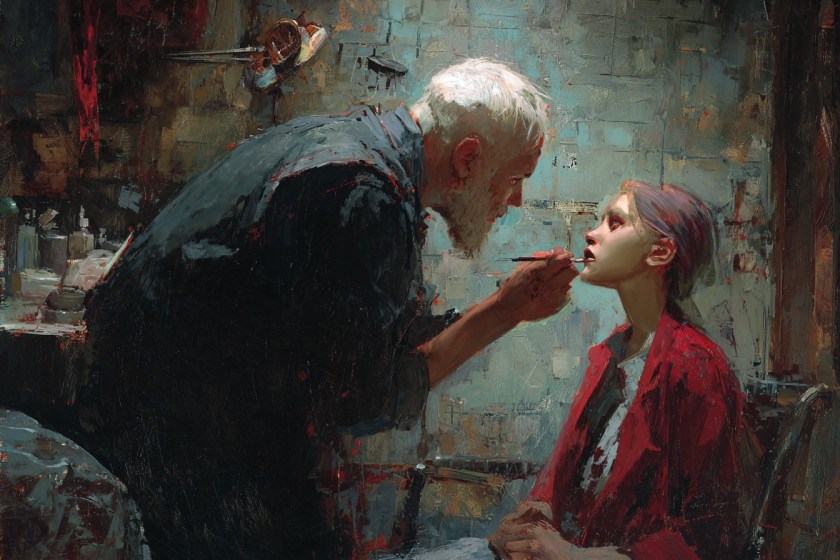
For this story I thought I would begin by seeing what image Midjourney would conjure up with the single-word prompt ‘Art’. It gave me a few but there was something abut this one that intrigued me.

I put the image into Claude with the prompt, ‘Use this unusual picture as a prompt for a somewhat eerie 300 word short story.’ I used the latest version of Claude which is Opus 4.6 and it took a while ‘thinking’ before it actually produced this story.

Continue reading “The Silent Portrait: A Tale of Artistic Horror”
Posted in stories

The Cost of an Apple: A Story of Transactions

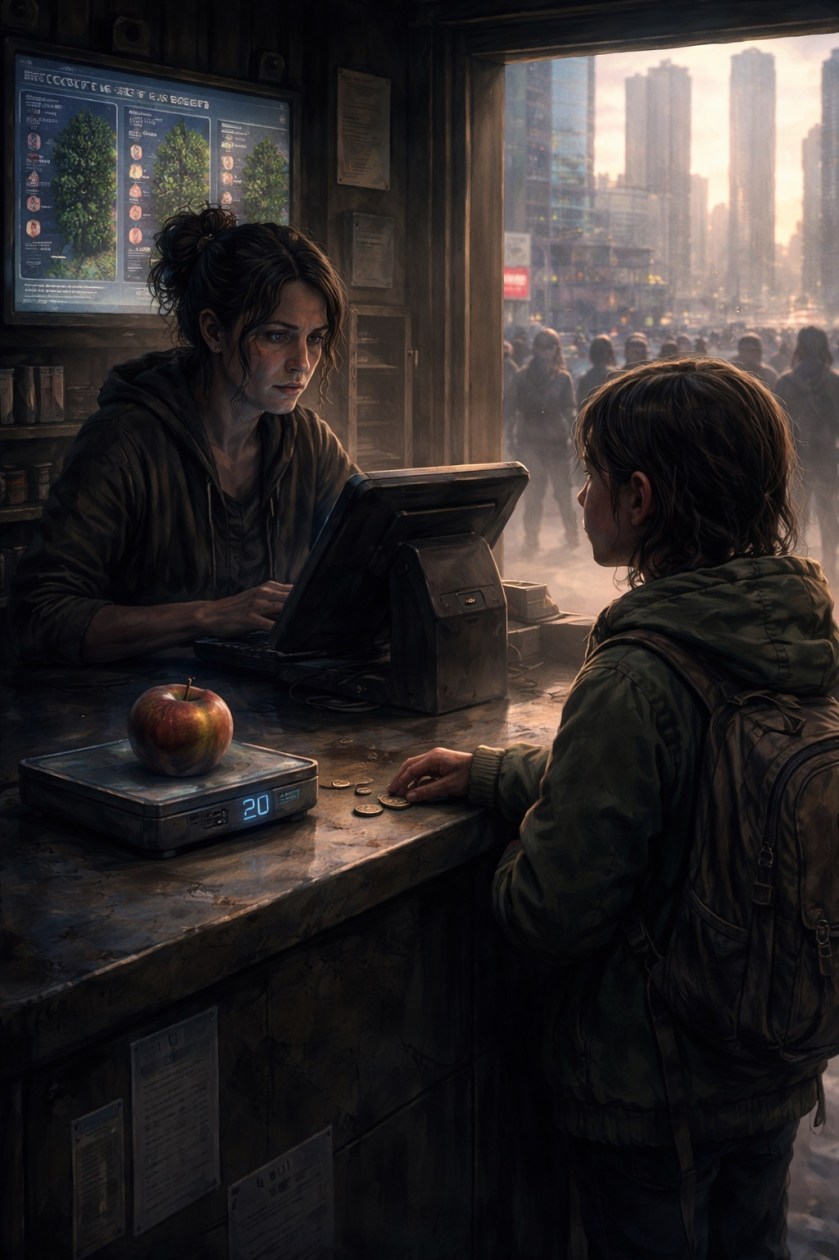
The child places the coins on the counter. Copper, not credit. The shopkeeper doesn’t look up from her screen.

‘Just this,’ the child says.

The apple sits between them, bruised along one side. Through the window, the grey towers catch the afternoon light, their upper floors bright with panels that drink the sun. Down here, the queue stretches into the street. Nobody speaks. The shopkeeper’s fingers move across her screen, logging, calculating.

Continue reading “The Cost of an Apple: A Story of Transactions”
Posted in AI and Creativity

More Graphic Comics

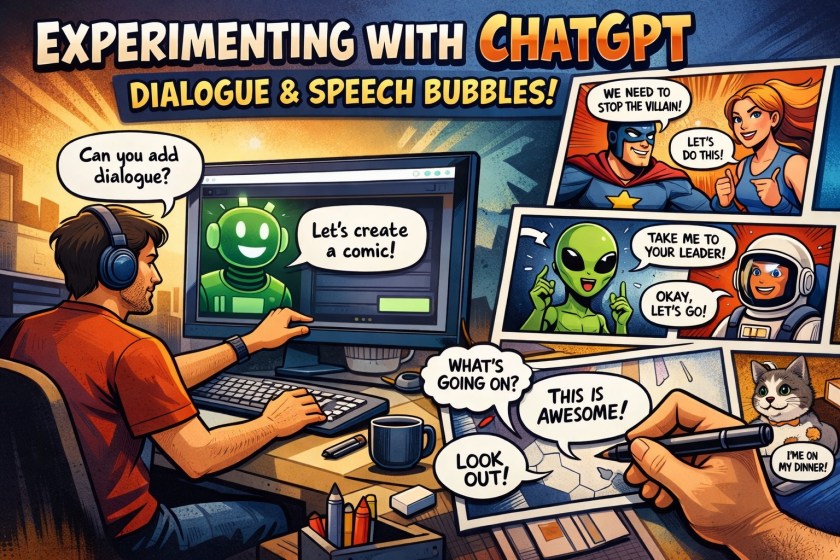
Last week I experimented with ChatGPT’s image creator to create some 6 panel graphic comics. Today I am seeing how well it can cope with dialogue and speech bubbles.

Continue reading “More Graphic Comics”
Posted in AI and Creativity

The Queue That Never Reached the Door

One Prompt, One Story, One Thought

Every now and again I give an AI a single prompt and let it write a short story. I do not edit the result. I simply choose one worth keeping. Below you will find the exact prompt, the story it produced, and one brief thought that stayed with me after reading. Nothing more.

One Prompt

“Write a short story of about 300 words set entirely in a queue that never seems to move. Do not explain why the queue exists. Focus on small actions and overheard fragments of conversation.”


One Story

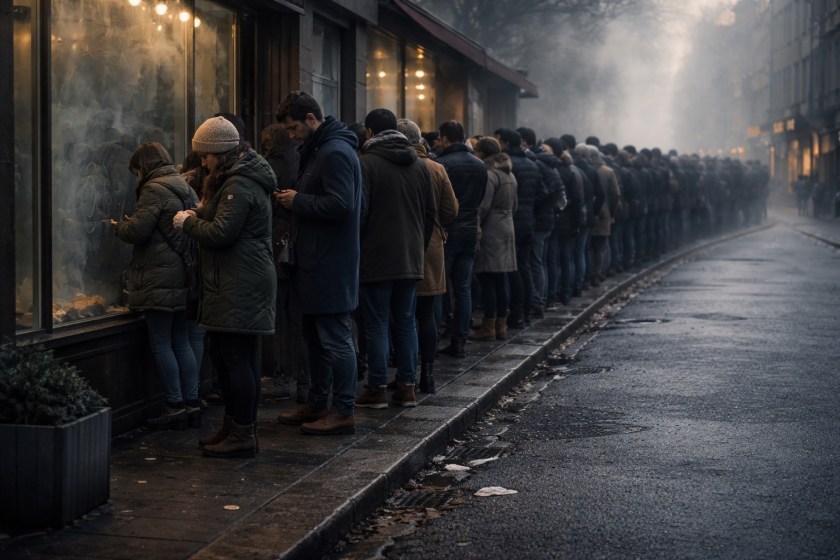
The queue curves along the pavement, shoes scuffed and aligned with the kerb. Someone rocks from heel to toe, then stills. A man lifts his phone, stares at the screen, lowers it again. A woman opens her bag, closes it, opens it once more as if something might have changed inside.

“I think it’s shorter than yesterday,” a voice says somewhere ahead.
“No, it just bends earlier,” another replies.

A child traces circles on the fogged glass of a shop window, wipes them away with a sleeve, starts again. A man peels the label from a bottle, sticks it to his thumb, peels it off. The wind carries the smell of coffee from somewhere unseen. Several heads turn at once, then face forward again.

“Is this the end?”
“For now,” someone says. A few people laugh, softly.

A woman checks the time and sighs. The man behind her apologises for nothing in particular. Someone drops a coin; it rolls, spins, settles against a shoe. Nobody claims it. A couple argue in murmurs about whose turn it is to step forward when the gap opens. The gap closes before either does.

The line shuffles, half a pace, then stops. Coats brush. A sleeve is smoothed. A scarf is loosened, tightened again. A man hums three notes of a tune, realises, stops.

“Do you remember when you could just walk in?”
“Only vaguely,” comes the reply. “It feels like a different place.”

A paper flutters past with yesterday’s date. A woman bends to pick it up, changes her mind. Someone offers a mint. Someone else declines, then accepts after a pause.

The front is still out of sight. People stand closer now, not because they are told to, but because space seems wasteful. Feet edge forward, then settle. The queue does not move. It holds them, and they hold it.


One Thought

The queue never moved, yet everything else adjusted around it. That felt less like patience and more like adaptation.

Posted in AI and Creativity

Has Claude Developed A Mind of Its Own?

I was recently staying in a hotel where the notepads by the side of the bed each had a motivational quote at the bottom of the page. It got me thinking, “Could AI write a story based on one of these prompts?” The answer – of course it could! i

The quote I chose was, “Continuous improvement s better than delayed perfection.” I gave Claude this quote, “I want you to use this quote as a prompt or idea for a sinister 200 word dystopian piece of flash fiction. Set in Manchester. ‘Continuous improvement s better than delayed perfection’.”

Here is the story it gave me…

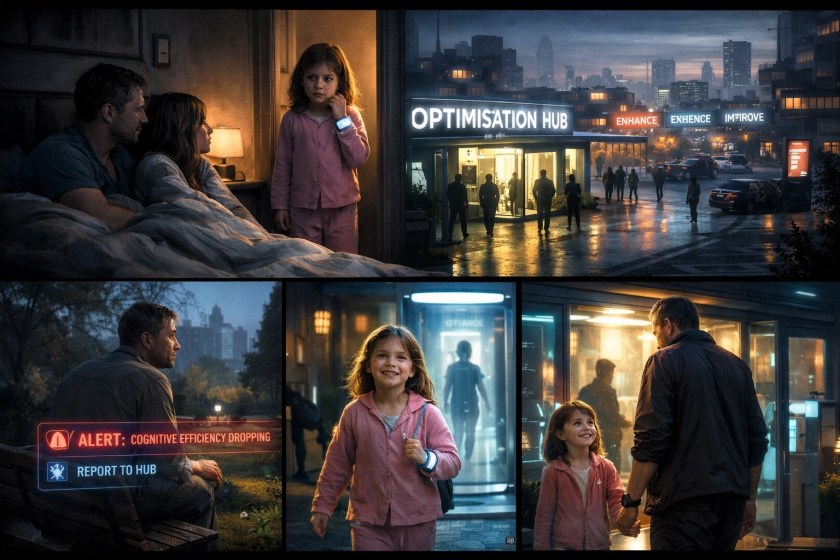
Personal Best

My daughter’s score dropped by 0.003 overnight.

The notification woke us at 4am, that soft, insistent chime from the monitor on her wrist. She’s seven. She stood in our bedroom doorway, crying, asking what she’d done wrong. Nothing, I wanted to say. You’ve done nothing wrong. You’re perfect. But we don’t use that word anymore.

The Optimisation Hubs line every street in Salford now. Twenty-four hours, no appointment necessary. You walk in with your deficiencies, walk out marginally improved. Sleep efficiency. Attention span. Empathy metrics. All adjustable. All improvable.

My daughter went in at 6am. Came out humming, her score restored, her tears forgotten. She’s been in fourteen times this year.

I remember when children just were. Before the metrics, before the monitors. My mother let me be bored. Let me fail. Let me sit in the garden doing absolutely nothing, becoming no one in particular.

Stagnation, they’d call it now.

My own score’s been slipping. I’ve started thinking about the old days too often. Unproductive cognition. The Hub sends gentle reminders—helpful nudges, encouraging incremental correction. My daughter watches me with her bright, optimised eyes.

“Daddy,” she says. “You should go. You’d feel so much better.”

She’s right, probably. Everyone feels better, after.


But Why?

What I found even more interesting than the story was its thinking behind the story. I’d asked Claude, “Why does this story fit the quote, explain your thinking behind it.” And it did…

The quote’s usually meant as reassurance, don’t obsess over getting things perfect, just keep iterating, shipping, improving. It’s a productivity mantra. Agile development. Kaizen. All very sensible.

But there’s something sinister lurking underneath if you push it far enough. If continuous improvement is better, then perfection isn’t just delayed, it’s undesirable. An endpoint. A stopping point. And if stopping is bad, then you must never be finished. Never be enough.

So the story takes that to its conclusion: a world where perfection is a forbidden concept, where children are monitored for microscopic fluctuations in their “score” and corrected immediately. A 0.003 drop is meaningless in absolute terms, but in a system built on continuous improvement, any backsliding, however tiny, is intolerable.

The daughter’s been “optimised” fourteen times in a year. She’s seven. She’ll never be permitted to simply be a child, to exist without measurement, because that would be stagnation. The narrator remembers boredom, failure, doing nothing, all now pathologised.

And the gentleness is the worst part. No one’s forcing anyone. It’s just… expected. Encouraged. Normal. The daughter has already internalised it so completely she’s nudging her own father toward correction.

The horror isn’t the improvement. It’s the continuous. The never-ending. The quiet abolition of “enough.”

A Final Thought

I asked Claude to give me its thinking behind the story it had written, but AI chatbots can’t ‘think’ – can they?

Let me know what you think.