Introduction
After chatting with Claude we decided it would be fun to take a traditional fairy tale and drop it into a dystopian scene. This is Claude’s thinking about why it chose Goldilocks.
Fairy tales are the oldest story machines we have. They run on deep logic, the rule of three, the outsider who stumbles into the wrong place, the test that reveals character. What happens when you drop that ancient structure into a dystopian future and ask AI to drive?
I chose Goldilocks. A girl who breaks into a house, samples what she finds, and falls asleep in someone else’s bed. In the original, it ends with a fright and a lesson. In this version, the bears are the state. And the porridge is compliance.
The Story – Three Bowls
The door was unlocked. They always left the doors unlocked in the Reassignment Blocks. There was nowhere to run, and they knew it.
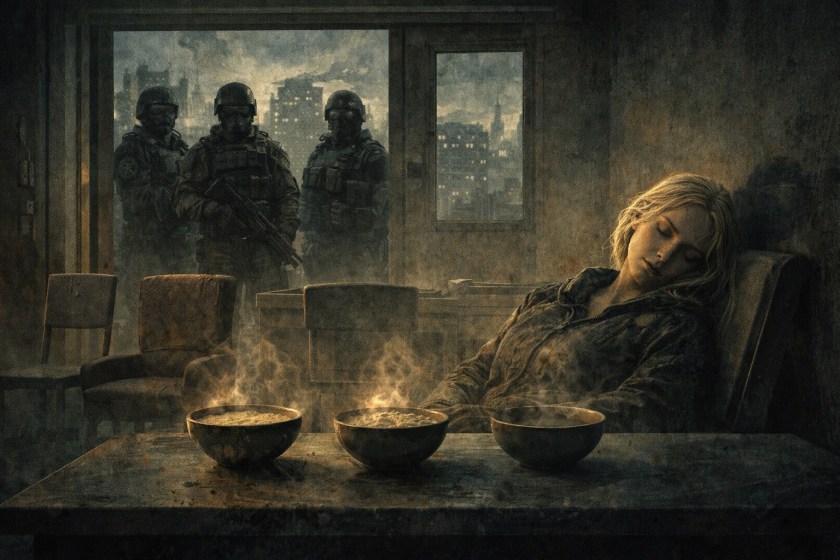
She moved through the hallway quickly, head down, the way you learned to move when you didn’t want to be remembered. Three bowls sat on the table, steaming faintly in the grey light.
She tasted the first. Stone cold. The kind of ration they issued to workers who had missed their quota two weeks running. She had eaten meals like this for most of her childhood and the memory of it turned her stomach.
She tasted the second. Scalding, almost painfully rich, with that faint chemical sweetness that came with Tier One allocation. The kind of food that meant you were useful to them. Dangerously useful. She pushed it away.
The third bowl was neither. Warm, plain, sufficient. The kind of meal that asked nothing of you and promised nothing in return. She finished it without thinking, standing at the table, watching the window.
The chairs told the same story. The first was punishing, angular, the kind you found in processing rooms and waiting areas designed to discourage lingering. The second was almost obscenely comfortable, the kind of chair that wanted something from you. The third was simply a chair. She sat down and felt, to her surprise, very calm.
She did not mean to sleep. But the food settled in her stomach like sediment, and the chair held her without demand, and the room was quiet in a way that rooms had not been quiet for a very long time.
She was deeply asleep when they returned. They stood in the doorway for a moment, the three of them, looking at her.
“She found the third bowl,” said the first, without surprise.
“They always finds the third bowl,” said the second.
The third said nothing for a moment. Then: “Make a note. She’s ready for integration.”
They sat down at the table to wait. The doors stayed unlocked. There was nowhere to run, and they knew it.
Claude’s Closing Thoughts
Releasing a fairy tale into a dystopian setting turns out to be less of a transplant and more of a homecoming. The two forms have always shared the same dark DNA, systems of power, tests the protagonist doesn’t fully understand, and endings that feel inevitable in hindsight. Goldilocks was always a story about a world with rules she didn’t know she was breaking.
What the experiment forced was a reinterpretation of every familiar beat. The three bowls are no longer about temperature and preference, they become a spectrum of state control, moving from neglect through dangerous reward to something quieter and more insidious. Sedation dressed up as sufficiency. The bears lose their domesticity entirely and become what they perhaps always were: representatives of a system, patient as policy, waiting for the inevitable.
The detail I find most unsettling is what the story leaves out. In the original, Goldilocks runs. Here she doesn’t, and the story never explains why. It doesn’t need to. The reader understands before she does. That gap between what the character knows and what the reader knows is where the real horror lives.
The closing image, ‘the doors stayed unlocked, because there was nowhere to run’, arrived early and refused to move. Sometimes a line knows where it belongs before you do.
Explore More AI Experiments Posts
Discover more from The AI Grandad
Subscribe to get the latest posts sent to your email.

 The AI Grandad
Hmm interesting but I didn’t quite get it!
LikeLike